Electricity here runs cheap
Colorado homes paid 14.92 cents per kilowatthour in 2024. That's below what a lot of the country pays to run the same equipment.
Takes about a minute. No obligation.
Gas heats 73.4% of homes in Douglas County, and most of those homes cool with central air tied into the same ductwork. A mini split works differently. It doesn't need ducts at all, which is why people look at one for a room the existing system doesn't reach well, or a space that was added on later. If your home is part of that gas-furnace majority, a mini split isn't replacing what you have. It's covering ground your main system wasn't built to cover.
NOAA nClimDiv, 1991–2020 normals
A mini split sized too big cools the room fast, then shuts off before it pulls the moisture out of the air.
Getting the size right means measuring the room, not guessing from the brochure.



Douglas County sits in climate zone 5B, a cool, dry zone where the energy code counts heating as the bigger job for any system. That code doesn't carve out a separate rule for ductless equipment. A mini-split heat pump counts as a split system, so any unit manufactured from 2023 on has to clear 14.3 SEER2 for cooling and 7.5 HSPF2 for heating, the same floor as a central heat pump. That rules out older or bargain models that fall under those numbers, even if the price looks good. A unit that clears the minimum may also qualify for the federal tax credit, worth checking against before you buy.
Cooling runs one month a year here, July, and the afternoon high averages 81 across the summer. That's not much heat for a system to work against. A mini split doesn't need to be the highest-efficiency model on the lot to hold up under a load that light. Put the money into getting the size right for the room instead.
Find a contractorAsk how many indoor heads the outdoor unit is meant to run, and whether this room is sharing capacity with one already installed or being added later. A system sized for a single head stretched across several rooms won't hold temperature in any of them once they're all calling for heat or cooling at once. Ask what the minimum operating temperature is on the compressor. Some units stop delivering heat once it gets cold enough outside, and that number tells you whether the system covers the cold snaps or quits when you need it most. Ask what the warranty covers on the compressor versus the line set and the indoor head, since those often carry different terms, and a compressor failure years in is a different repair than a clogged condensate line. A unit sized right from the start asks less of its parts than one short-cycling against a bad match.
Colorado homes paid 14.92 cents per kilowatthour in 2024. That's below what a lot of the country pays to run the same equipment.
A mini split with a higher SEER2 number costs more up front, and cheap power stretches out the years it takes to earn that back. Put the weight on sizing and build quality instead of chasing the top efficiency tier.
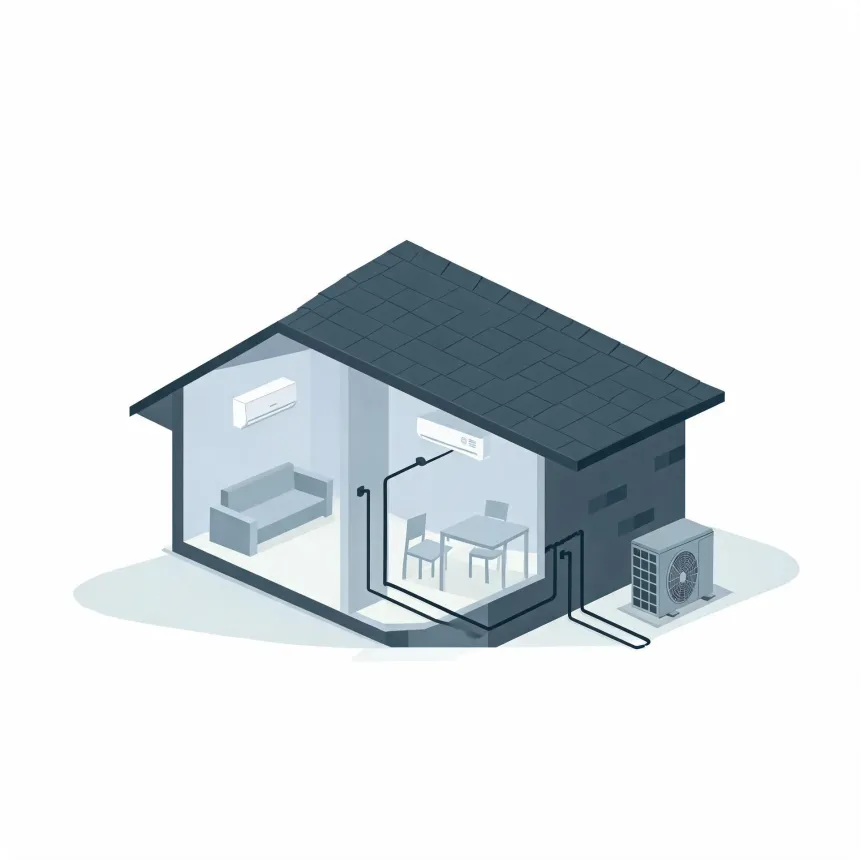
If you're adding the mini split rather than replacing a system outright, the old equipment doesn't go anywhere. A ducted furnace and central air still heat and cool the rest of the house the way they always did. The mini split just takes over the one room on its own circuit, running independent of whatever the main system is doing. If you are replacing an old window unit or a baseboard heater with a mini split, that equipment comes out, and the room's heating and cooling load shifts over to the new indoor head entirely. Either way, the contractor doing the install can tell you what's worth pulling and what's fine left in place.
The quote covers more than the box on the wall. Running the line set means opening a path through the wall for refrigerant lines, power and the condensate drain, and the distance between the outdoor unit and the indoor head decides how much of that work there is. A short, straight run through one wall costs less to install than a run that climbs through a second floor or snakes around the outside of the house. Where the outdoor unit sits matters too. It needs clearance to pull air through the coil and a path for the condensate to drain away, and a mounting pad or bracket adds to the job if there's no good spot waiting. The electrical side counts as well. Some mini splits run on the same circuit as a household outlet, others need a dedicated circuit run from the panel, and if the panel is already full, that's its own piece of work before the indoor head ever goes up.