





Aerial view of a gray central air conditioning condenser unit on a concrete pad next to a house with vinyl siding.

AC Repair in Durango, CO

Tell us about the job

Takes about a minute. No obligation.

RepairCentral ACLa Plata County, CO
Step 1 of 2

What ZIP code is the job in?

Half the homes in La Plata County were built in 1993 or later. If yours is one of them, the house itself is not old, and there's a good chance the air conditioner isn't either. Newer construction means less history for a system to have racked up: fewer years of wear, fewer owners who might have let it run on a dying capacitor or a slow leak. If the house is young, the odds favor a system still well inside its working life. That's worth knowing before you decide whether a repair is worth paying for.

79°F
the average summer afternoon it cools against
8 hail events
in ten years, and hail bends the fins on outdoor coils
30 wind events
in ten years, and wind drives debris into outdoor units
Isometric cutaway illustration of a house interior showing ducted HVAC piping, an indoor air handler unit, and an outdoor condenser with fan connected by a line, rendered in grey tones on a white background.
Your air conditioner works hardest from July through August.

NOAA nClimDiv, 1991–2020 normals

Most AC failures start with a worn capacitor or a dirty, neglected coil, not a dead compressor.

A system that's quit here is more often a cheap part than a lost cause, worth a look before anyone writes it off.

Your AC has never had to work very hard here

Summer afternoons average 79°F
30 damaging wind events from 2015 to 2024
8 hail events from 2015 to 2024

Before calling anyone, check the thermostat is set to cool and the setting is actually below room temperature. Go to the breaker panel and make sure the breaker for the outdoor unit hasn't tripped. Look at the air filter. If it's gray and clogged, swap it, since a blocked filter starves the system of airflow and can shut it down on its own protections. Walk outside and look at the condenser. If the fan isn't spinning and you don't hear a hum, that's worth noting for whoever comes out. Check that nothing is stacked against the outdoor unit or blocking its sides, since it needs open air to shed heat. If you see ice on the refrigerant lines or the indoor coil, turn the system off entirely and let it thaw before anyone touches it further.

An easy life means a repair usually makes sense

A system that has spent its life topping out around 79 degrees has had an easier run than most, and that work is usually worth finishing with a repair rather than a replacement. The parts wearing out now are more likely doing it from age sitting in the cabinet than from years of hard runs. Get it looked at and fixed.

Find a contractor
An outdoor residential air conditioning condenser unit mounted on a concrete pad, surrounded by gravel with a blue sky in the background.

Check its age before you count it out

Find the install date on the unit's data plate or the permit from when the house was built. If the house is one of the newer ones in the county, that date is probably not far behind it. A system that's only had a handful of summers behind it, each one mild on the compressor, still has most of its working life ahead. That's the case for fixing what's wrong now instead of weighing a replacement.

A frozen coil needs airflow, not more runtime

Once ice forms on the indoor coil or the lines, the system is losing its ability to cool, not gaining it. Ice is an insulator, so the coil absorbs less heat from the air every cycle it keeps running, and the compressor keeps working against a line that's partly blocked. Left alone, that ice can spread until it jackets the whole coil and starves the compressor of the cool refrigerant gas it needs to stay safe, which is how a cheap airflow problem turns into a compressor replacement.

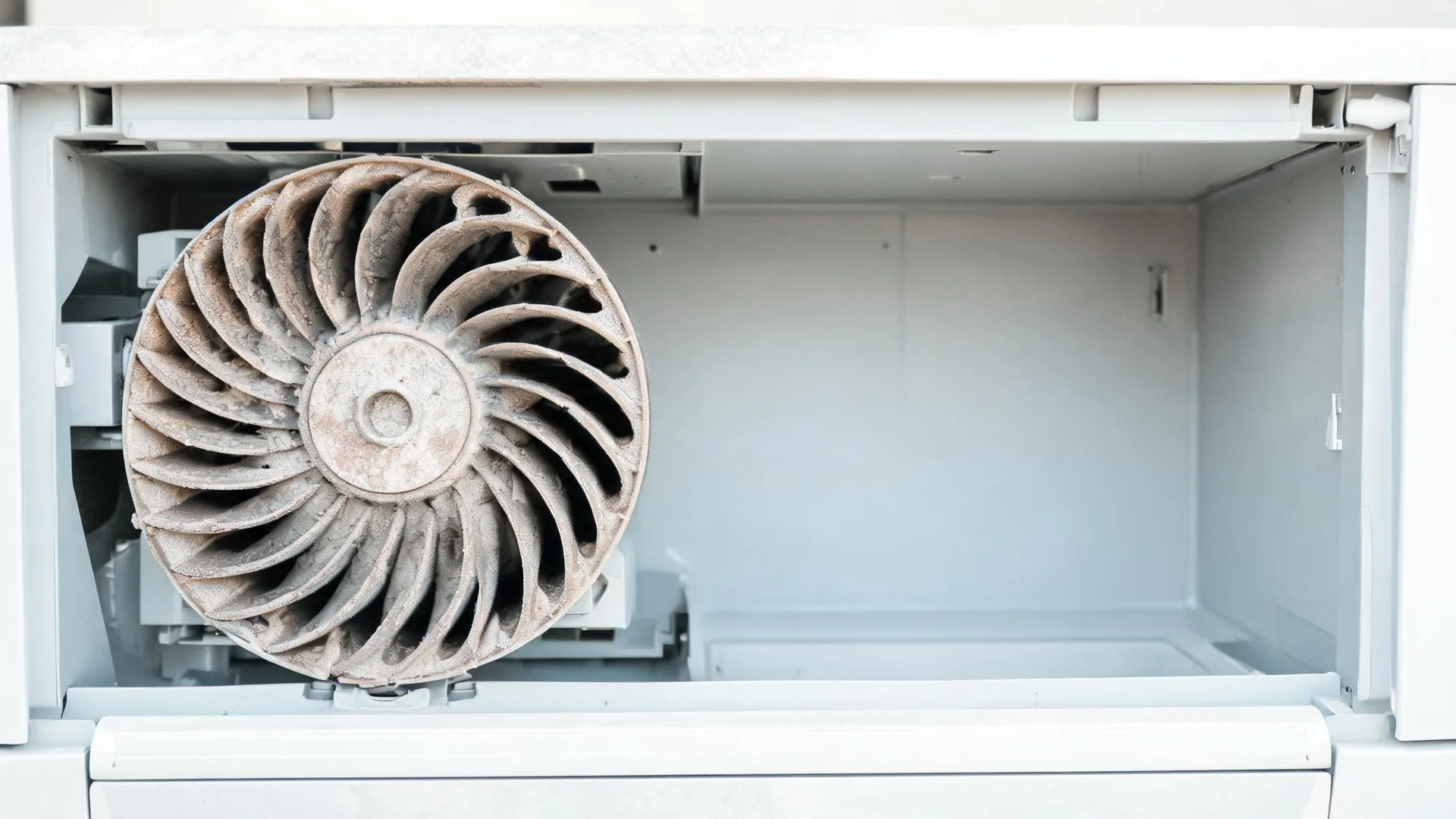
A struggling system needs a diagnosis, not a reset

Flipping the breaker or turning the thermostat off and on might get the system running again for a while, but it doesn't tell you why it stopped. A capacitor that's weakening will keep weakening every time the compressor has to start against it. A refrigerant leak will keep leaking whether the system runs or not, and running it low on charge makes the compressor work harder to move what's left. Getting a tech out while the problem is small and the part is cheap beats waiting for the part it's protecting to fail.

Overhead view of an air conditioning condenser unit on a concrete pad next to a house with asphalt shingle roofing and vinyl siding.

A new air conditioner would save little on running costs in La Plata County, so the repair decision comes down to the unit's condition.

  • An older air conditioner$60 a year
  • A new one at the federal minimum, 13.4 SEER2$60 a year

Estimates for a typical La Plata County home, compared with an older unit built to the previous federal minimum, from EIA household energy data, Colorado fuel prices and NOAA climate normals. Your home will differ.

Repair makes sense when a part like a capacitor or contactor has failed.

Replacement makes sense when the compressor has failed or the system uses R-22 refrigerant, which is no longer made.

Most of the time, the choice between fixing and replacing comes down to what actually broke. A capacitor, a contactor, a fan motor, these are wear parts, and swapping one doesn't say anything bad about the rest of the system. A compressor is different. It's the one part that's expensive to replace and hard to justify replacing on its own, since the labor to swap it costs nearly what a new system would. So the real question a tech is answering isn't how old the unit is, it's which category the failure falls into. A system that's thrown a run of small, unrelated problems over the years is still a system worth fixing. One that's asking for a compressor is the one worth stopping to think about.