
AC making a loud noise in Castle Rock, CO

A Douglas County pro who repairs air conditioners gets your request.

Get my match

A loud noise from your AC usually means something inside has come loose, worn out, or is hitting something it shouldn't. A rattle is often a loose panel or screws, shaken by the unit running hard through a Castle Rock summer. A squeal points to the blower motor or a belt bearing losing lubrication. Grinding or metal-on-metal sounds mean something inside the compressor or motor is failing. A loud bang when the system starts or stops can mean a compressor part has broken loose. None of these get quieter on their own, and most get more expensive the longer the unit keeps running that way. If the noise is new and the air still feels cool, you likely have some time to get it looked at. If the sound comes with warm air or the system cycling off, treat it as more urgent.

A gray outdoor air conditioning condenser unit on a concrete pad beside a house with horizontal siding and a stone veneer base, with a wall-mounted disconnect box and conduit, next to a shrub bed and a concrete patio.

Normal running sound

A healthy condenser hums steady once it kicks on, with the fan on top turning smooth and even. Stand near the disconnect box and you'll hear the compressor settle into a low, constant tone. No clanking, no screeching, nothing that changes pitch or gets louder as it runs.


An outdoor air conditioner condenser unit on a concrete pad beside a house with light gray vinyl siding, with a gray electrical disconnect box and conduit on the wall, gravel beds and dried plants nearby, and a concrete sidewalk in the foreground.

Noise that means trouble

An older unit like this one, sitting out through enough Castle Rock summers, starts telling on itself. Rattling from loose panels, grinding from a failing motor bearing, or a hard clank on startup all mean a part has worn down or come loose. Weeds and gravel pressed against the housing can also rattle against it in the wind.

Repair the Noise or Replace the Unit

Keep running, call for repair

  • A new noise doesn't mean the unit is done, it means one part has worked loose or worn out while the rest of the system is still fine.
  • Most loud-noise calls trace back to one fix: a loose panel, a worn blower motor bearing, a failing contactor, or a fan blade knocking against its cage.
  • A contractor can confirm the cause on site in one visit since the noise itself usually points straight to the source.
  • Shutting the unit off when you first hear grinding or screeching keeps a worn part from damaging the motor or compressor around it.
  • Running the system a few more days while you arrange a repair rarely changes the outcome if you turn it off once the noise turns severe.

Consider replacement

  • If the compressor itself is the source of a deep, heavy knocking sound, that's usually not a part a contractor replaces on its own.
  • A unit that's needed several repairs for different problems over the past couple of summers may be nearing the point where another fix just buys a short stretch of time.
  • Replacement resets the clock, so you're not weighing a new repair bill against the system's age every time something else wears out.
  • A newer system matched to your home's size runs quieter day to day, since the fan and compressor aren't working as hard to keep up.
A gray outdoor air conditioning condenser unit on a concrete pad beside a house with horizontal lap siding, with a conduit and electrical disconnect box on the wall and a green shrub in mulch to the right.

What a quiet unit looks like

The grille is clean and the pad underneath is clear. A unit like this gets a once-over at the start of summer and nothing is left sitting against it. Dirt and old leaves never get the chance to build up on the coil.

A weathered outdoor air conditioner condenser unit on a concrete pad beside a house with horizontal vinyl siding, with a conduit and disconnect box on the wall to the right.

What neglect sounds like

Leaves and grime packed into the grille block airflow across the coil, and the fan has to fight through the debris to turn. A unit left like this through enough Castle Rock summers wears unevenly, and that uneven wear is where the noise starts.

Is this noise something you need to worry about

You probably noticed it from another room first, a rattle or a bang that doesn't match the usual hum from the side yard. Maybe it only happens when the unit kicks on, or maybe it's steady the whole time it runs. You might hear it through an open window, or feel it more than hear it, a vibration that carries into the house. If it's been going on for a few days and nobody's looked at it, the part making that noise is still wearing against whatever it's hitting. Left alone through a hot stretch, a loose or worn part can take out something bigger next to it, and the unit may stop cooling the house altogether right when you need it most.

A woman in a gray turtleneck sweater sits on a beige sofa in a living room, looking toward a curtained window with blurred greenery outside.
A woman in a brown knit sweater leans back on a sofa with her eyes closed and arms spread along the cushions, in a blurred indoor room with a window, potted plant and kitchen counter behind her.
A woman in a cream sweater sits on a gray sofa with textured cushions, smiling and looking off to the side, with a blurred living room, plants and a pendant lamp behind her.
A woman in a dark green sweater sits on a gray sofa in a living room with a large houseplant, a framed picture, a fireplace, and windows in the background.

Get matched with an air conditioner pro in Douglas County

Send the request today and let an air conditioner pro reach out to you.

You only hire the pro if you want to.

Why the noise gets worse over time

A loose part doesn't stay the same size problem. A panel screw that's backed out a quarter turn lets the panel shift a little more each time the compressor cycles on, and a Castle Rock unit cycles on a lot through a hot, dry July afternoon. A blower bearing that's just starting to wear roughens up further every hour the fan spins. What sounds minor now is usually the early version of a part that will fail outright if it keeps running unchecked. Catching it while it's still a rattle instead of a grinding stop is what keeps a repair small.

What the sound tells a contractor

Where the noise happens and when it starts narrows down the cause before anyone opens the cabinet. A sound that starts the instant the unit kicks on points to something different than one that builds up after it's been running for twenty minutes. A noise from the outdoor unit means something different than one coming from the vents inside. That's why it helps to notice exactly when you hear it and where it seems to come from. Those details are what a contractor uses to go straight to the right part instead of inspecting the whole system piece by piece.

An older woman with gray hair in a patterned knit sweater smiles while looking to the side in a dimly lit kitchen, with a round loaf of bread on a wooden counter in the foreground and a lit oil lamp and potted plant on a windowsill behind her.
A woman with dark hair in a bun holds a sleeping child wrapped in a knitted beige blanket on a sofa, with a lit lamp and a window behind them.

Call now

If the noise is new, loud, or getting worse, get a contractor out before the part that's wearing gives out completely and leaves you without cooling.

Send it today

Keep an ear on it

A faint, steady sound that isn't changing can wait a few days, but note when it happens and whether it's getting louder before you decide.

Send it today

Cooling runs July through July

In Douglas County, that's July, one month a year. That short stretch is when a loose panel or a bad bearing gets found, because it's the only month your AC runs long and hard enough to shake it loose and let you hear it.

NOAA nClimDiv 1991-2020

An outdoor air conditioner condenser unit on a concrete pad beside a house with horizontal lap siding, with a conduit running to a gray electrical disconnect box on the wall.
Before you get your air conditioner repair
A gray outdoor air conditioner condenser unit on a concrete pad beside a house with horizontal lap siding, with a wall-mounted disconnect box and conduit at left and a green shrub and mulch bed at right.
After you get your air conditioner repair
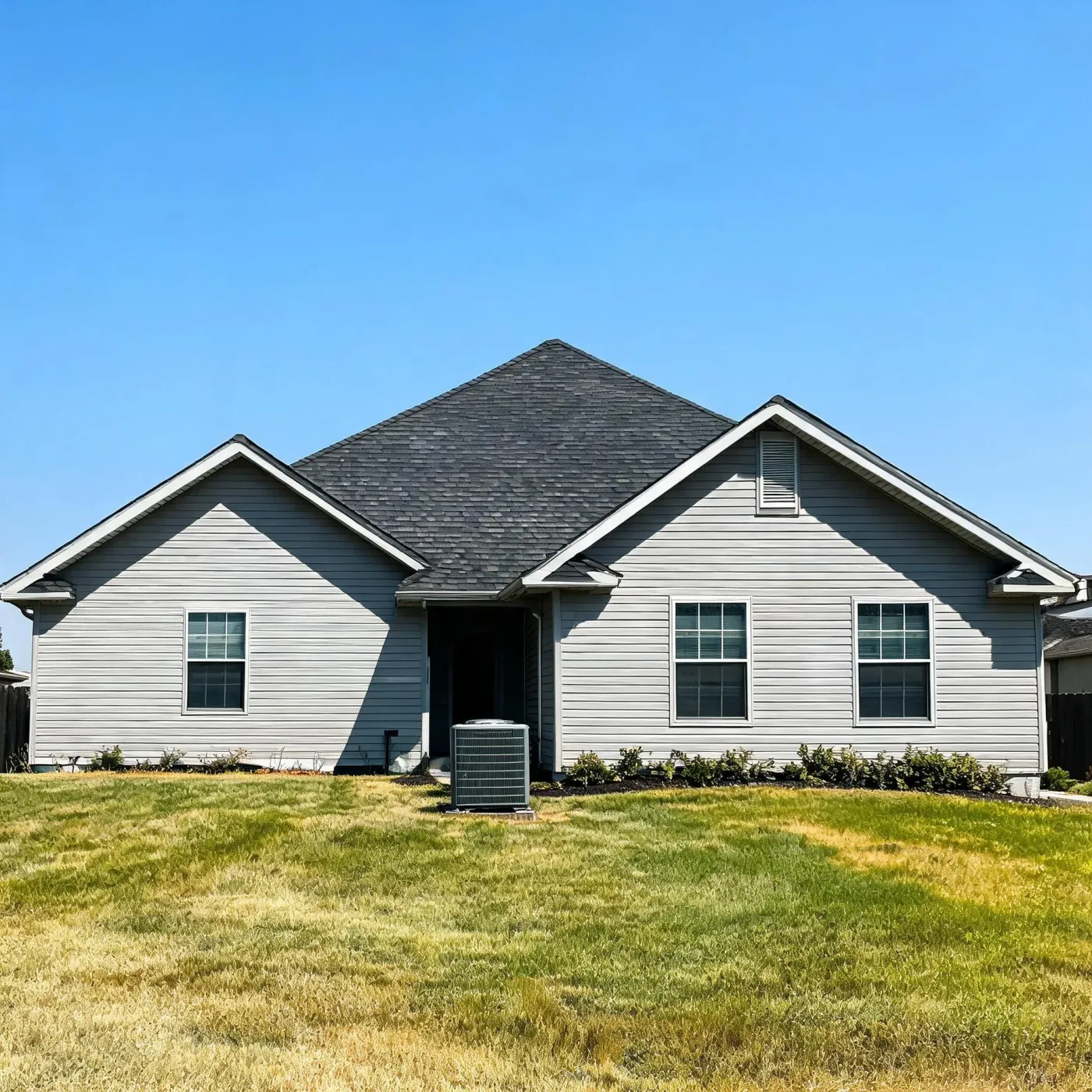
A single-story house with light gray horizontal siding, dark shingled gable roofs, and white-trimmed windows, with an air conditioning unit beside a recessed entry and a partly dry lawn in front under a clear blue sky.

Summer air in Douglas County carries a dew point around 42°F, which is dry as these things go, according to NOAA climate data. Dry air like that makes your AC's job a little easier on the cooling side, since it doesn't have to wring much moisture out before the house feels comfortable. But that same dry air pulls dust and grit through the return vents and across the coil and blower wheel, and that grit is what loosens a panel screw or wears down a blower bearing faster than you'd expect. A noise that shows up in July often started as dust working its way into a joint that used to sit tight.

NASA POWER T2MDEW

A man in a blue sweatshirt and cap carries a red and black tool bag up a paved walkway toward a house entrance where another man in a tan sweater stands in the open doorway, with stone-clad columns, wall lights, and potted mums nearby.

A noise like this has an answer, not a mystery

A loud noise is your AC telling you something came loose or wore down. It's not a reason to replace the unit, and it's not something to just live with through the rest of July. Most of the time it's one part: a panel, a bearing, a blade. Find that part and the noise stops.

You don't have to figure out which part it is before you do anything. A contractor who works on these units in Douglas County every summer can listen to it, open the panel, and tell you in minutes what's loose or worn. Send the form and that part of the job is off your plate. Someone who knows this equipment reaches out to you directly, and from there it's a straightforward fix, not a guessing game you run yourself.

Interior corner of a dining room with a round wooden table, a ceramic vase holding olive branches, a dark spindle-back chair near a curtained window, and a sideboard with a lamp against beige walls.
A lit flagstone walkway bordered by low path lights and shrubs leads to the covered front entry of a light-colored clapboard house with a dark door, flanking potted plants, and a glowing porch light at dusk.

Air Conditioner Repair

The right pro for this job

RepairCentral ACDouglas County, CO
Step 1 of 2

What ZIP code is the job in?

  • A beige upholstered armchair with a green throw pillow and cream knit blanket sits on a shag rug beside a lit table lamp, a potted plant, and a woven basket.
    • Your request goes to a Douglas County pro who takes air conditioner jobs.
    • Tell a local repair pro what your air conditioner is doing.
  • A ceramic table lamp with a round speckled base and tapered linen shade sits on a wooden table beside a small shallow bowl holding pine cones, with a leafy plant and bright window to the left and a framed picture on the wall behind.
    • Send it once and finding someone is no longer on you.
    • Once you send the form, finding a pro is off your list.
  • Interior corner with a light wood built-in shelving unit holding a woven basket, a plant in a stone bowl and a dark vase, beside a window showing green trees, a beige upholstered sofa with a textured pillow and cream throw, a stone wall, and a large stone vase in the foreground.
    • Explain the air conditioner problem once instead of to every shop in Douglas County.
    • Skip calling shops to ask who repairs air conditioners in Douglas County.
  • A large matte ceramic vase holding leafy green branches stands on a wood floor beside a light upholstered sofa, with a window and gray wall in the background.
    • A licensed pro who repairs air conditioners in Douglas County gets your request.
    • A licensed pro who works in Douglas County gets your request.