August is the month to get it looked at
Heat pumps here start running in September and stay on through June. August is the last quiet month before that load hits, and it's the easiest time to get a technician out before the schedule fills up.
Takes about a minute. No obligation.
Heat pumps here start running in September and stay on through June. August is the last quiet month before that load hits, and it's the easiest time to get a technician out before the schedule fills up.
A heat pump that was already struggling usually makes it through the easy months. The first real cold snap is what finds the bad capacitor or the low charge, so trouble showing up now often points to something that was already wearing thin.

Winter nights in Archuleta County average 13°F in December, January and February.
Cold like that is what a heat pump has to work hardest against, and it's when a weak capacitor or low charge finally shows itself.



Colorado electricity ran 14.92 cents per kilowatthour in 2024, on the higher side for the country. A heat pump that's low on charge or losing a capacitor doesn't shut off, it just works harder to hit the temperature you set, and every one of those extra hours shows up on the bill. That's true whether the unit is struggling to keep up or running fine. Here it costs more while it does it.
If yours has been running longer than it used to, that's not something to watch for a while. At 14.92 cents a kilowatthour, those extra hours add up every month until the fix happens. Have a technician check the charge and the capacitor now.
Find a contractorA weak capacitor still starts the compressor most of the time, just slower, and a system that starts slow pulls harder on the windings every single cycle. Run it long enough in that state and the compressor itself takes the damage, which is a different repair than swapping a capacitor. The same goes for a low charge. A system short on refrigerant doesn't stop, it just runs longer to move the same heat, and the compressor ends up working against pressures it wasn't built to sit at for hours at a stretch. Frost on the outdoor coil follows the same pattern. A little frost clears in a normal defrost cycle, but if something's keeping the system from defrosting right, that frost thickens into ice, and ice blocks the airflow the unit needs to do anything at all. None of this announces itself. The system keeps heating, just worse and longer, until the part that was compensating gives out.
A heat pump in defrost or struggling to shift between heating and cooling will run long cycles, blow air that isn't the temperature you expect, or hang up with frost on the outdoor coil that doesn't clear on its own. That's usually a reversing valve stuck partway or a defrost sensor not telling the board what it needs to know.
A hard bang at startup, a grinding sound from the outdoor unit, or a burning smell from the vents means a part is already failing, not about to. Shutting it off and getting a technician out before running it again keeps a bad capacitor or a failing motor from taking something else down with it.
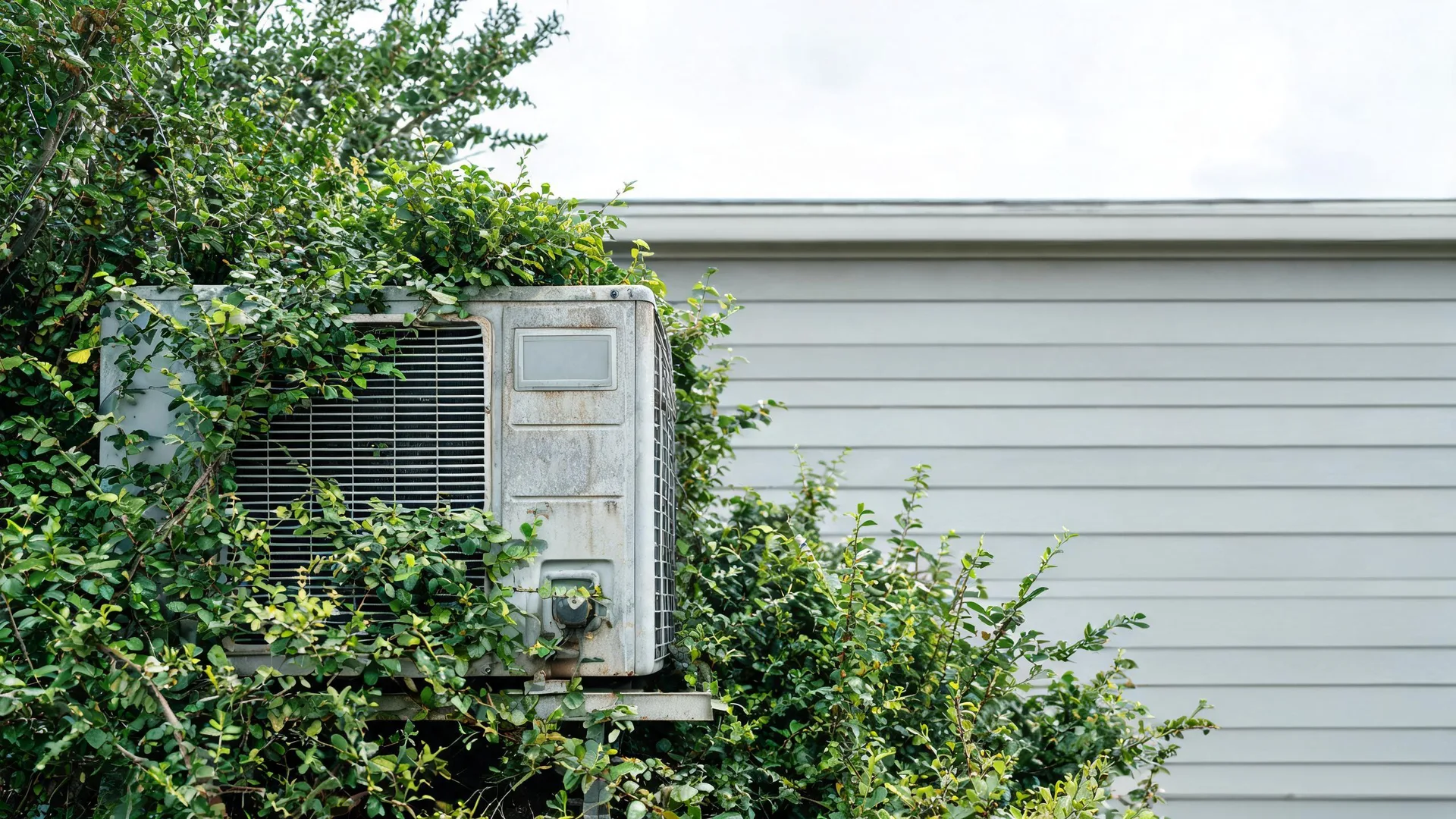
Before calling, look at the outdoor unit. If the coil is caked in ice and it's not in a defrost cycle, or frost never clears after one, that's worth noting but don't chip at it yourself. Check the thermostat is actually set to heat and the temperature is above room temperature, simple as that sounds, it gets missed. Look at the air filter. A filter clogged with dust makes the system work harder and can cause icing that looks like a bigger problem than it is. Walk around inside and feel the vents in each room, cold air out of every vent when it should be heating points to one kind of problem, warm air in most rooms but not one tells you something different. Listen for a hard bang at startup or any grinding from outside. If you hear either, shut the system off and wait for a technician rather than cycling it again.
A technician starts outside at the unit itself. Gauges go on to check the refrigerant charge and pressures, because a system low on refrigerant can cause the same weak heat as a failing part, even though the fix is nothing alike. The capacitor and contactor get checked next, since a capacitor on its way out can still run the system, just not well, right up until it can't. Voltage to the compressor and amp draw on the fan motor get tested too, to catch a motor pulling harder than it should before it fails outright. Then the reversing valve gets tested, since that's what switches the system between heating and cooling, and a valve stuck partway explains a lot of the odd behavior homeowners notice. The defrost board and thermostat wiring usually get looked at last, once the bigger parts are ruled out.