






Illuminated timber-and-stone luxury homes along a residential street at dusk, with snow-capped mountains visible in the background.

Heat Pump Repair in Manassa, CO

Tell us about the job

Takes about a minute. No obligation.

RepairHeat PumpConejos County, CO
Step 1 of 2

What ZIP code is the job in?

A heat pump in Manassa works harder in winter, with overnight lows averaging 9°F across December, January and February. That cold doesn't damage the system by itself. It just means the heat pump runs longer to keep up, and any existing weak point, a low refrigerant charge, a failing defrost control, a worn contactor, shows up sooner. Winter storms are common here too, but ice and heavy snow don't change what's actually wrong with the unit. If your heat pump is struggling, the cause is probably the same one a technician would find in any cold climate. Getting the right diagnosis matters more than the weather outside.

11 months
August through June, your system heats
9°F
the average winter night it heats against
73°F
the average summer afternoon it cools against
Isometric cutaway illustration of a single-story house showing interior ductwork, an indoor air handler and furnace unit, and an outdoor condenser connected by a line, on a white background.

Heat in Conejos County starts up in August and runs almost the whole year, through June.

July is the month to get a heat pump looked at, before the first cold week finds the weak part.

Most of what goes wrong here is the same thing that goes wrong anywhere else

161 severe weather events from 2015 to 2024
13% of homes statewide lost power a day or more in 2024
24 damaging wind events from 2015 to 2024
Running badly here costs more every monthColorado electricity ran 14.92 cents per kilowatthour in 2024.

Half the homes in Conejos County were built in 1982 or earlier, half later, and a heat pump doesn't care which. What matters is what's inside the walls, the line set, the air handler, the thermostat wiring, whatever was put in and whenever it was put in. Mobile homes make up a real share of the housing here too, and those sometimes run a package unit or a system sized tighter to the space. That can change where a technician looks first, not what's likely wrong. A failing capacitor or a stuck reversing valve acts the same in an old house or a new one.

Get the usual fix

Nothing about this area is especially hard on it. It's most likely the usual problem with the usual fix.

Find a contractor
A gray heat pump condenser unit mounted on a concrete pad against the gray lap-siding exterior wall of a house.

Left alone, a small problem runs the compressor into a big one

A heat pump that's struggling still tries to do its job, and that's the problem. A low refrigerant charge makes the compressor run longer to move the same amount of heat, and that extra runtime is what burns it out early. A failing defrost control can let frost build on the outdoor coil instead of clearing it, and the system keeps pulling air through a coil that's losing its ability to transfer heat, so it runs even longer to compensate. A worn contactor arcs a little more every cycle it's asked to make, and more cycles means it fails sooner rather than later. None of these get better with time or more runtime. The system doesn't know it's struggling, it just keeps drawing power and pushing the compressor to make up the difference, right up until something gives out completely instead of partially.

What you can check yourself

Look at the thermostat first. Make sure it's set to heat and the setpoint is actually above room temperature. Check the breaker for both the indoor air handler and the outdoor unit, a tripped breaker on either side shuts the whole system down. Pull the air filter and hold it up to a light. If you can't see light through it, it's choking airflow and that alone can make a heat pump seem broken. Walk outside and look at the outdoor unit. Snow or ice piled against the cabinet, or leaves and debris packed into the coil fins, blocks the airflow it needs to move heat.
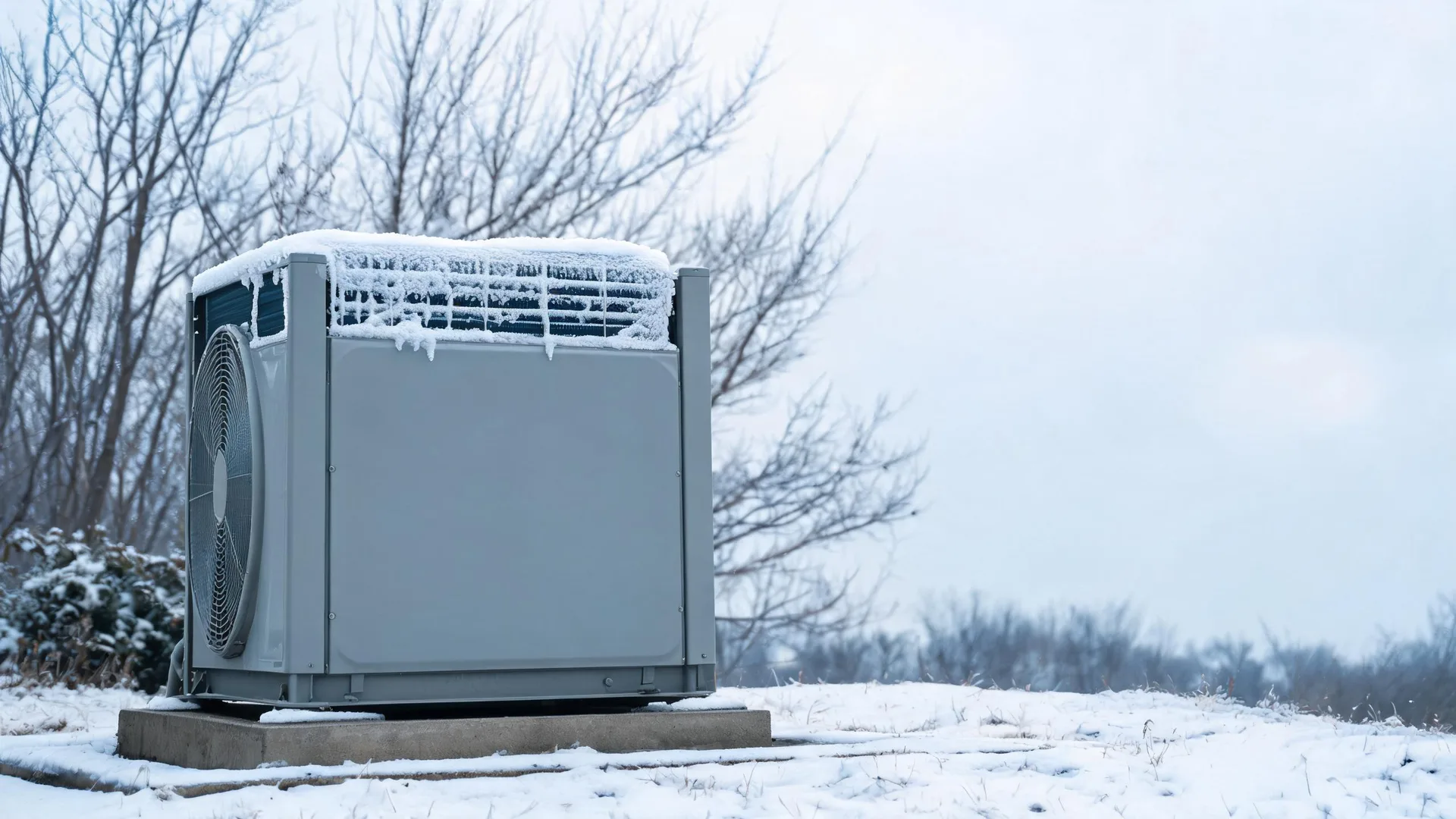
What tells you to call now instead of waiting

A thick coat of ice on the outdoor coil that doesn't clear during the defrost cycle means something's wrong with the defrost control or the reversing valve, not the weather. Warm air blowing when the thermostat calls for heat, or the outdoor fan not running at all while the indoor blower does, points to the same kind of fault. A burning smell, a tripped breaker that won't stay reset, or a compressor that hums but won't start are not things to keep testing on your own. Those are electrical or mechanical failures that get worse every time the system tries to run.

Most heat pump failures trace back to a handful of parts, and they fail the same way whether the unit is in a basement or on a slab. The reversing valve is a common one. It's what switches the system between heating and cooling, and when the coil inside it wears or the solenoid that drives it burns out, the unit can get stuck in one mode or stop switching cleanly. A failing run capacitor is another. It gives the compressor and fan motors the jolt they need to start, and a weak one leaves a motor humming without turning over, or turning over slow enough to trip overload protection. Refrigerant leaks show up at brazed joints and fittings over the years, and because the charge has to be exact, even a small leak drops capacity and makes the compressor work harder than it should. Contactors wear from the simple act of opening and closing a circuit thousands of times. They pit, they stick, and eventually they stop making contact at all. None of this is particular to any climate. It's just what happens inside a machine that cycles on and off for years.

So when is a heat pump worth fixing and when is it not. A single failed part, a capacitor, a contactor, a defrost control board, is almost always worth repairing on its own. Those parts fail one at a time, and swapping one out brings the whole system back to normal. The harder call is a compressor. It's the most expensive part in the system, and if it's failing from years of strain, the rest of the unit has usually logged just as many hours and isn't far behind. A refrigerant leak deserves a closer look too, since a line set that's leaked once tends to leak again somewhere else as it ages. The honest question isn't how old the unit is, it's whether the part that failed is a part on its own or a sign the whole system is reaching the end of its working life.