






A snow-covered small-town street at dusk, lined with illuminated two-story houses and a grain elevator on the horizon.

Heat Pump Repair in Lamar, CO

Tell us about the job

Takes about a minute. No obligation.

RepairHeat PumpProwers County, CO
Step 1 of 2

What ZIP code is the job in?

Heat pumps in Lamar earn their keep from October through April, seven months of straight work. September is when a weak part finally gets found, right before the system has to run every day. A capacitor or contactor that was marginal all summer can fail the first cold morning it has to push heat instead of pull it. If your heat pump is struggling now, early in the season, that's not bad luck. That's the extra load finding the weak spot it was already sitting on.

7 months
October through April, your system heats
4 months
June through September, it cools
19°F
the average winter night it heats against
91°F
the average summer afternoon it cools against
Isometric line illustration of a cutaway single-story building showing interior rooms, ceiling ductwork, an indoor air handler, and an outdoor condenser unit connected by refrigerant lines.
Your system heats October through April and cools June through September.

NOAA nClimDiv, 1991–2020 normals

A heat pump runs cooling and heating duty in the same year, so its parts wear from both directions.

The reversing valve and the contactor take that double wear, which is why they tend to fail first.

Half the homes in Prowers County date to 1971 or earlier, old enough for a heat pump to be on its second or third one

Half the homes here were built by 1971
132 damaging wind events from 2015 to 2024
115 hail events from 2015 to 2024

A heat pump that keeps running but never gets the house to temperature is often stuck heating or cooling less than it should, which points to the reversing valve or a refrigerant charge that's dropped. Ice on the outdoor unit that doesn't clear during the defrost cycle is worth a call, since a healthy system melts itself off a few times a day without you noticing. Listen for the outdoor fan hesitating to start or humming without turning, that's usually the capacitor giving out. If the system switches on and off in short bursts instead of running a full cycle, a failing contactor or a clogged filter restricting airflow can both cause it. Warm air blowing when you've set it to heat, or the reverse, means the reversing valve isn't shifting the way it should. Any of these is worth having looked at before the part fails completely rather than just struggling.

A heat pump running wrong is still running up your bill

Electricity here runs 14.92 cents a kilowatt-hour, and a heat pump working both a heating and cooling load all year gives a weak part plenty of chances to cost you before it quits for good. A struggling capacitor or a reversing valve that won't shift right doesn't fail quietly. It just runs up your bill every month until someone looks at it.

Find a contractor
A man in a cap, brown work jacket and tan cargo pants carries a canvas tool bag as he climbs wooden porch steps toward a red front door, with a potted evergreen shrub beside the entry.
A residential heat pump outdoor unit mounted on a concrete pad next to a house with gray vinyl siding.

What a repair means on an older system

If your heat pump came with a house built in 1971 or earlier, ask the contractor how much life it has left before agreeing to a repair. A reversing valve or compressor on a system that old may not be worth fixing. That's a different question than what's broken right now, and worth asking before the work starts, not after.

Check the thermostat and the filter first

Set the thermostat below room temperature and listen for the system to kick on within a minute. If it doesn't respond, check the batteries before anything else. Then pull the filter and hold it up to a light. If you can't see light through it, airflow is choked and the system may be shutting itself off to protect the coil long before any part has actually failed.
Look at the outdoor unit, but don't touch it

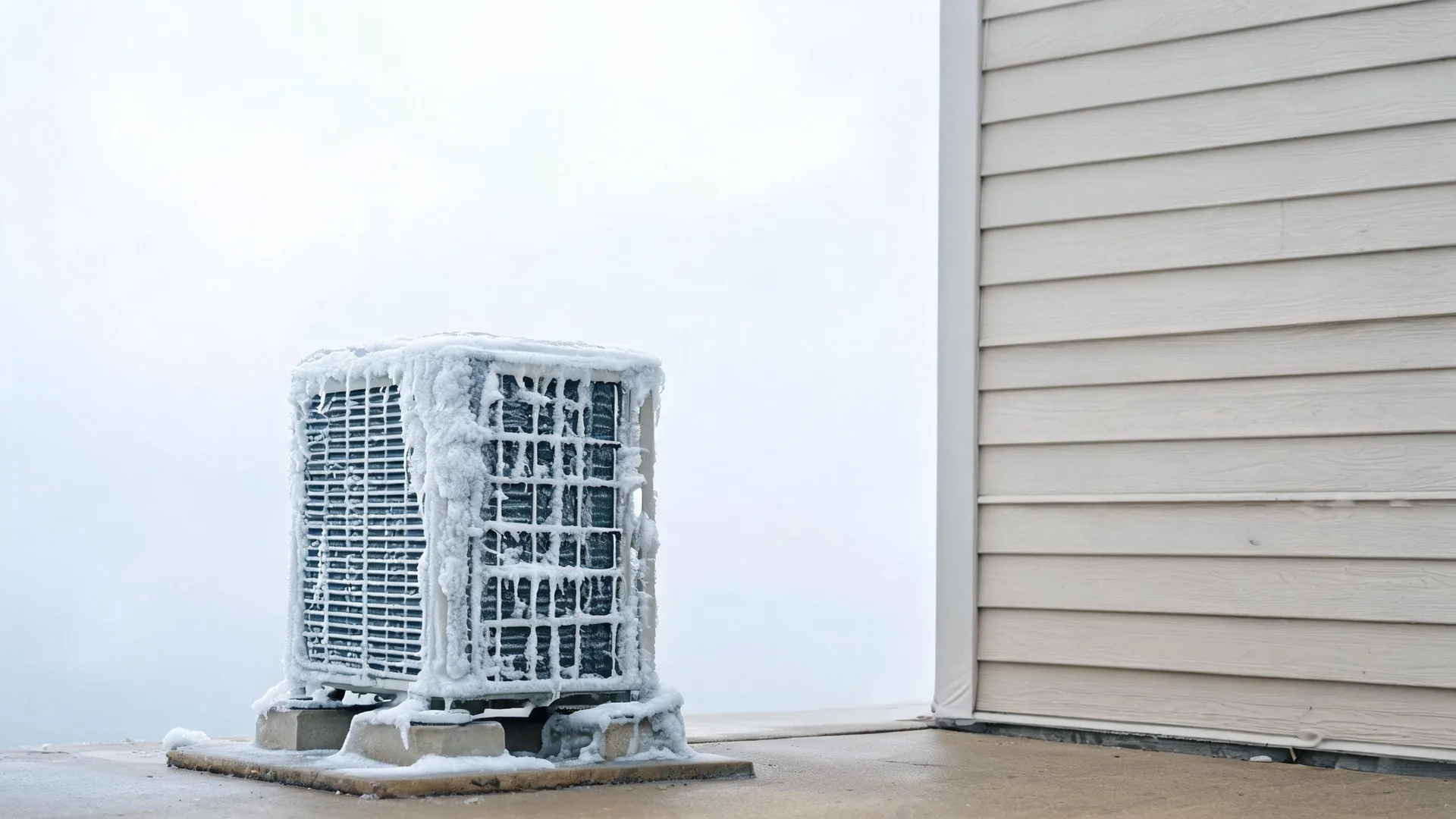
Walk outside and see if the fan is turning and if air is actually coming off the coil. Clear away leaves, grass clippings or anything stacked against the cabinet, since blocked airflow outside causes a lot of the same symptoms as a failing part. Frost or ice on the coil is worth noting and mentioning on the call, but don't chip it off or spray it, that's a job for whoever comes out.

A heat pump that's struggling still has to run, since it's the only thing standing between the house and the temperature outside. That's what makes a weak part different from a broken one. A failing capacitor makes the compressor draw harder every time it starts, and it keeps doing that, cycle after cycle, until it trips something or burns out. A refrigerant leak behaves the same way. The charge doesn't fix itself between cycles, so the compressor keeps working against a system that's lost some of what makes it efficient. Ice that doesn't clear during defrost is the clearest case. Left alone it builds with every cycle instead of melting off, until airflow is blocked enough to affect the compressor itself. None of this fixes itself by waiting.

A diagnostic call starts with gauges, not guesses. A tech hooks up manifold gauges to check the refrigerant charge on the high side and the low side, since that tells them more than anything they can see by eye. They run the system in whichever mode it's failing in, heating or cooling, because a problem that shows up pushing heat may not show up pulling it. Expect them to check amp draw on the compressor and the outdoor fan motor, since a motor pulling too many amps is usually close to the end. They test the capacitor directly rather than guess from the symptoms, and they cycle the reversing valve to see if it actually shifts when it's told to. Most of this happens at the outdoor unit, and most of it is over before they tell you what they found.