A gravel road curves between dark wood cabins with metal roofs and a split-rail log fence, surrounded by tall conifer trees under an overcast sky.

Heat Pump Repair in Elizabeth, CO

Tell us about the job

Takes about a minute. No obligation.

RepairHeat PumpElbert County, CO
Step 1 of 2

What ZIP code is the job in?

August is when heat pumps here show their weak spots

Heat here starts running in September, and August is the month before it. A heat pump that struggled last winter or sat with a marginal part all summer will usually show it the first cold week it has to work hard.

A repair now means it is sorted before the load hits

Getting a heat pump looked at in August catches a weak capacitor, a low charge, or a failing component before the system has to run daily. Waiting until September means diagnosing the same problem with the house already depending on it.

9 months
September through May, your system heats
2 months
July through August, it cools
15°F
the average winter night it heats against
84°F
the average summer afternoon it cools against
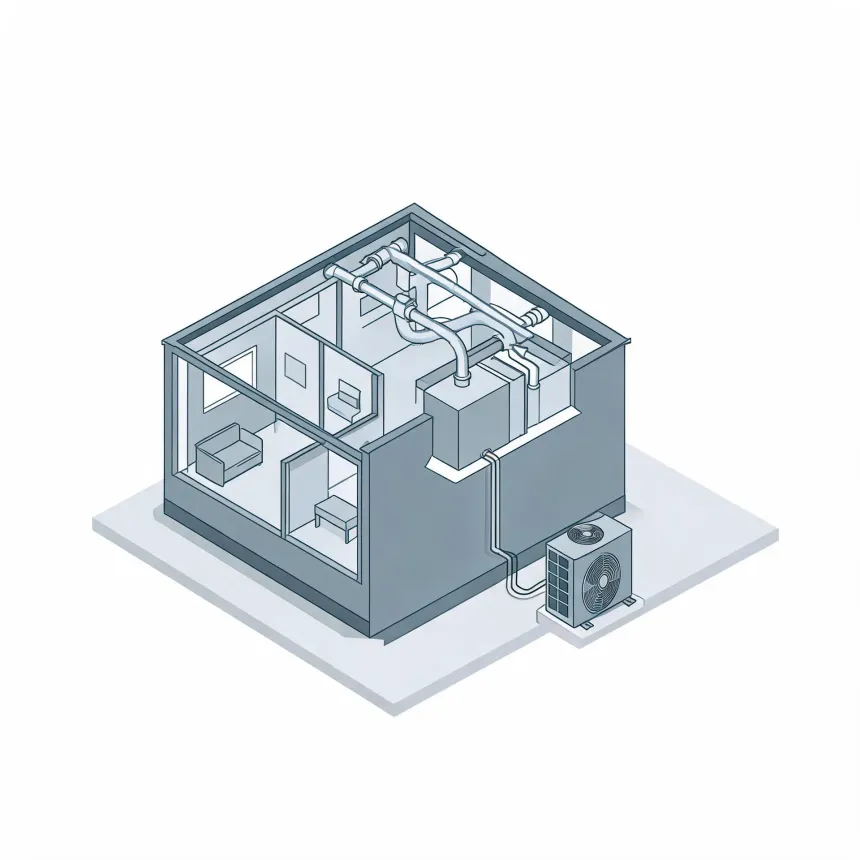
Isometric line illustration of a cutaway house showing interior rooms with furniture, ceiling ductwork connected to an indoor air handler, and refrigerant lines running to an outdoor condenser unit on a pad.
Your system heats September through May and cools July through August.

NOAA nClimDiv, 1991–2020 normals

Elbert County gets hail, wind and winter storms like the rest of the region, but none of it targets a heat pump any harder than normal.

When a heat pump here breaks, it is almost always a normal part failure, the kind any contractor can diagnose and fix.

Half the homes here were built in 1996 or later, and the heat pump is often the same age

Half the homes here were built by 1996
83 damaging wind events from 2015 to 2024
165 hail events from 2015 to 2024

Colorado electricity ran 14.92 cents per kilowatthour in 2024. A heat pump that's low on charge or working around a bad capacitor pulls more power to do the same job, so a problem that seems minor still shows up on the bill every month it runs. That cost doesn't wait for you to get around to it. The part that's failing now keeps costing you until it's replaced.

This is a normal repair, not a mystery to solve

Elbert County sees its share of wind, hail and winter storms, but none of it wears on a heat pump any differently than it would anywhere else. Whatever is going on with yours is most likely a known part failure with a known fix. Getting it diagnosed now is what settles it, one way or the other.

Find a contractor
A gray outdoor HVAC unit mounted on a concrete pad beside a house with gray lap siding and a stone foundation.

A newer heat pump is worth fixing

If your heat pump came with a newer build here, it's likely still within its working life. That's the case for repair over replacement most of the time. A part failing now, a capacitor or a low charge, doesn't mean the unit is done. It means one part needs attention while the rest of the system keeps the years it has left.

What you can check before you call

Look at the outdoor unit first. If the coil is packed with leaves, grass clippings or ice, clear it off and see if that alone changes anything. Inside, check the thermostat is set to heat or cool as you expect, and swap the batteries if it has a blank or dim display. Pull the air filter and hold it up to a light. If you can't see through it, replace it. None of this calls for opening the unit up or touching any wiring.

What to leave for the contractor

If the outdoor unit is frozen over even after a day with the system off, stop and wait for a technician. The same goes for a grinding or screeching noise. A breaker that trips more than once, a smell of burning, or water pooling near the indoor unit all mean one thing. Shut it off and don't reset it again. A heat pump that runs constantly without warming or cooling the house needs a gauge set and a trained eye, not a guess.

A heat pump that's struggling doesn't fail all at once. It compensates, and that compensating is what does the damage. A compressor working against a low charge runs longer to reach the same temperature, and that extra runtime wears the same parts a normal cycle would wear, just faster. A weak capacitor makes the compressor draw a hard start every time it kicks on, and each hard start puts more stress on the motor windings. Left alone, a problem that started as a simple repair turns into a failed compressor, which is the heart of the system. The unit will keep running right up until the part it's leaning on hardest gives out.

Some repairs are worth it and some aren't, and the difference usually comes down to the compressor. A capacitor, a contactor, a blower motor, a defrost board, these are parts that fail on their own schedule and have nothing to do with how old the compressor is. Replacing one brings the system back to normal and the rest of the unit doesn't care. A compressor failure is a different question, because a heat pump is built around that compressor and nothing else in the cabinet does its job. When that's what failed, a contractor is really asking whether the rest of the unit has enough life left to justify the cost of the one part that keeps everything else running. There isn't a clean rule for that. It comes down to what shape the rest of the system is in, and that's a judgment a technician makes standing in front of it, not one anyone can make from a symptom over the phone.