






Illuminated timber-and-stone houses line a residential street at dusk, with evergreen trees in the foreground and a silhouetted mountain range behind them.

Heat Pump Repair in Aspen, CO

Tell us about the job

Takes about a minute. No obligation.

RepairHeat PumpPitkin County, CO
Step 1 of 2

What ZIP code is the job in?

Winters here get cold. Overnight lows average 10°F across December, January and February, and the county sees plenty of heavy snow and ice each season. That's real demand on a heat pump, but it's normal for this part of Colorado. It's not what breaks a system on its own. When a heat pump stops keeping up or starts short cycling, the cause is usually something a technician sees all the time. A low refrigerant charge. A failing defrost sensor. A reversing valve stuck in one position. The cold just makes the symptom show up sooner. Find the actual part at fault and the repair is straightforward.

10°F
the average winter night it heats against
70°F
the average summer afternoon it cools against
Isometric line illustration of a cutaway single-story house showing interior rooms with furniture and ceiling ductwork, connected to an outdoor condenser unit on the ground outside the left wall.

Colorado electricity ran 14.92 cents per kilowatthour in 2024.

A heat pump that's struggling pulls more power every hour it runs this way, so the longer the real problem sits, the more it costs you.

Half the homes in Pitkin County were built in 1985 or later, maybe yours

Half the homes here were built by 1985
65 winter storms from 2015 to 2024
Winter nights average 10°F
The cost adds up fastAt 14.92 cents a kilowatt-hour, a heat pump working harder than it should shows up on the next bill.

If your heat pump came with a newer place, it hasn't hit the age where parts just wear out on their own. A reversing valve stuck in one position or a defrost sensor reading wrong isn't about the unit being old, it's one part doing its job wrong. That's worth fixing rather than replacing. Check the paperwork from when you bought the house, or look for an install sticker on the unit itself, and you'll know how old the system actually is. A repair is the right first call either way.

Get the usual fix

Nothing about this area is especially hard on it. It's most likely the usual problem with the usual fix.

Find a contractor
A gray outdoor HVAC unit mounted on a concrete pad beside a house with gray lap siding and a stone foundation.

What all that running adds up to

A heat pump runs in both directions, all year, and that is what makes it different from a furnace that only fires up in winter. The part unique to this machine is the reversing valve, the one that switches it between heating and cooling. The defrost cycle leans on it too. Every time the system reverses to clear frost off the outdoor coil, the valve, the defrost sensor, and the control board all have to do their part correctly. Get thousands of cycles into a system and it's not strange for one of those parts to start reading wrong or sticking partway, no matter how new the unit is. The outdoor coil matters here too. Caked with dirt or bent fins, it can't give up heat the way it should, and the system ends up running longer to make up for it. None of this means the unit is worn out. It means one part stopped doing its job, and that is what a repair fixes.

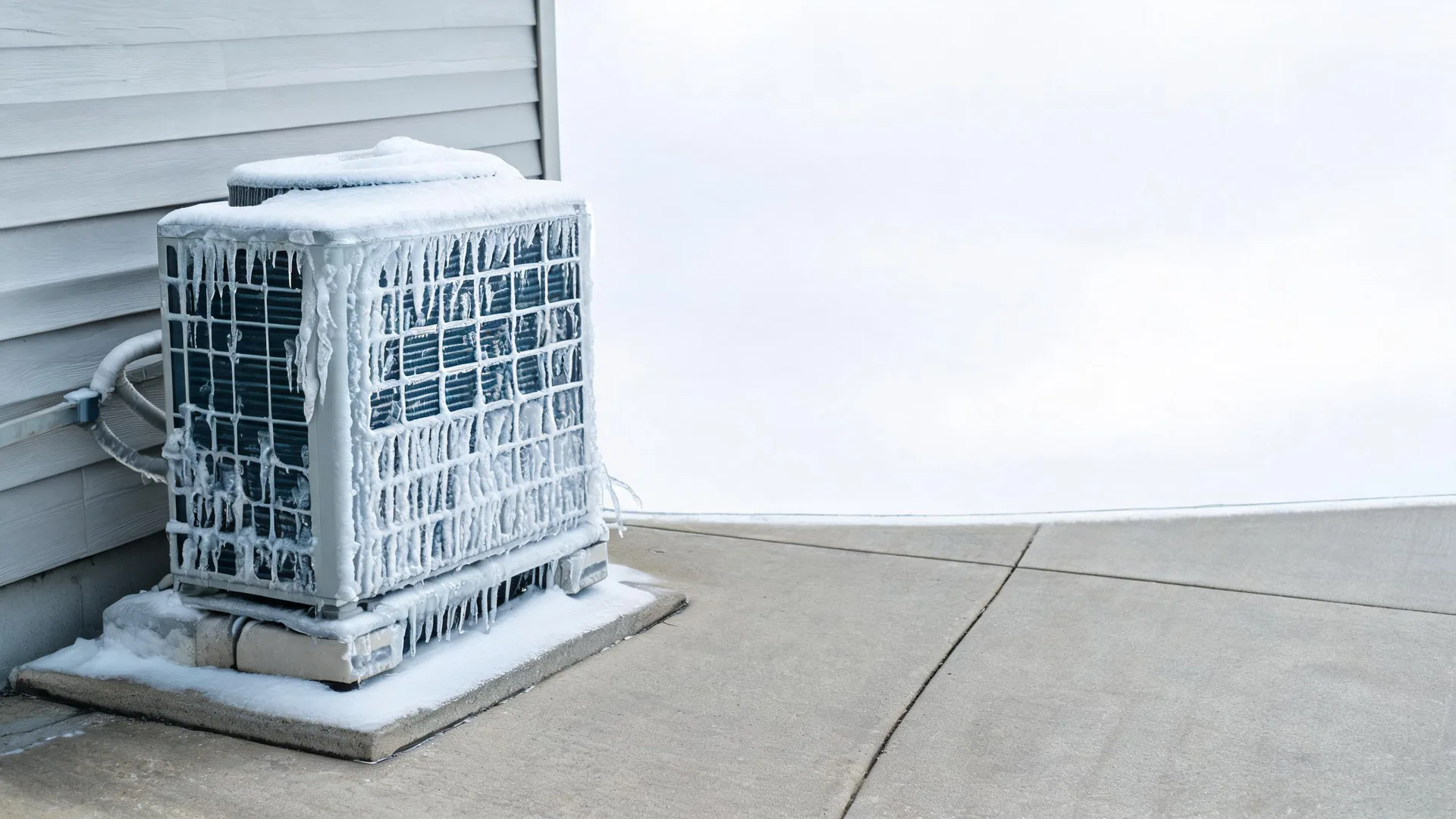
Ice does not stay put

A reversing valve that's slow to shift or a defrost sensor reading wrong leaves frost sitting on the outdoor coil longer than it should. That ice spreads across the fins and blocks airflow the coil needs to work at all. The system keeps calling for defrost cycles trying to fix it, and each one it gets wrong makes the coil harder to clear the next time.
The compressor pays for it

A heat pump low on charge or fighting a stuck valve makes the compressor work to move heat it can't move efficiently. Run it that way long enough and the compressor itself takes the wear, not just the part that's actually failing. A problem that starts as a bad sensor or a low charge can end as a compressor that needs replacing, which is a different repair than the one you started with.

Most people notice a heat pump problem before they notice a part name. The house feels cold even though the system is running, or it's running constantly and never seems to shut off. Sometimes air coming out of the vents feels cool when it should feel warm, which usually points to the reversing valve not switching the way it should. Ice building up on the outdoor unit and staying there is another one, especially if the system doesn't seem to be running its defrost cycle to clear it. A clicking or buzzing sound when the system tries to switch modes is worth paying attention to as well. None of these mean the whole unit is done. They mean a specific part is failing at its one job, and that's what a repair call sorts out.

A heat pump failing doesn't mean it's done. Most of what goes wrong is one part. A valve, a sensor, a capacitor not doing its one job. Swap that part and the system comes back. The one exception is the compressor. A technician can't just swap it out the way they would a sensor, and a system that's lost its compressor is usually better replaced than repaired. There's no way to guess which one you're looking at from how the system is acting. A technician has to look at it either way. Short cycling or blowing cool air is usually a repair. A compressor that's quit is a different conversation.