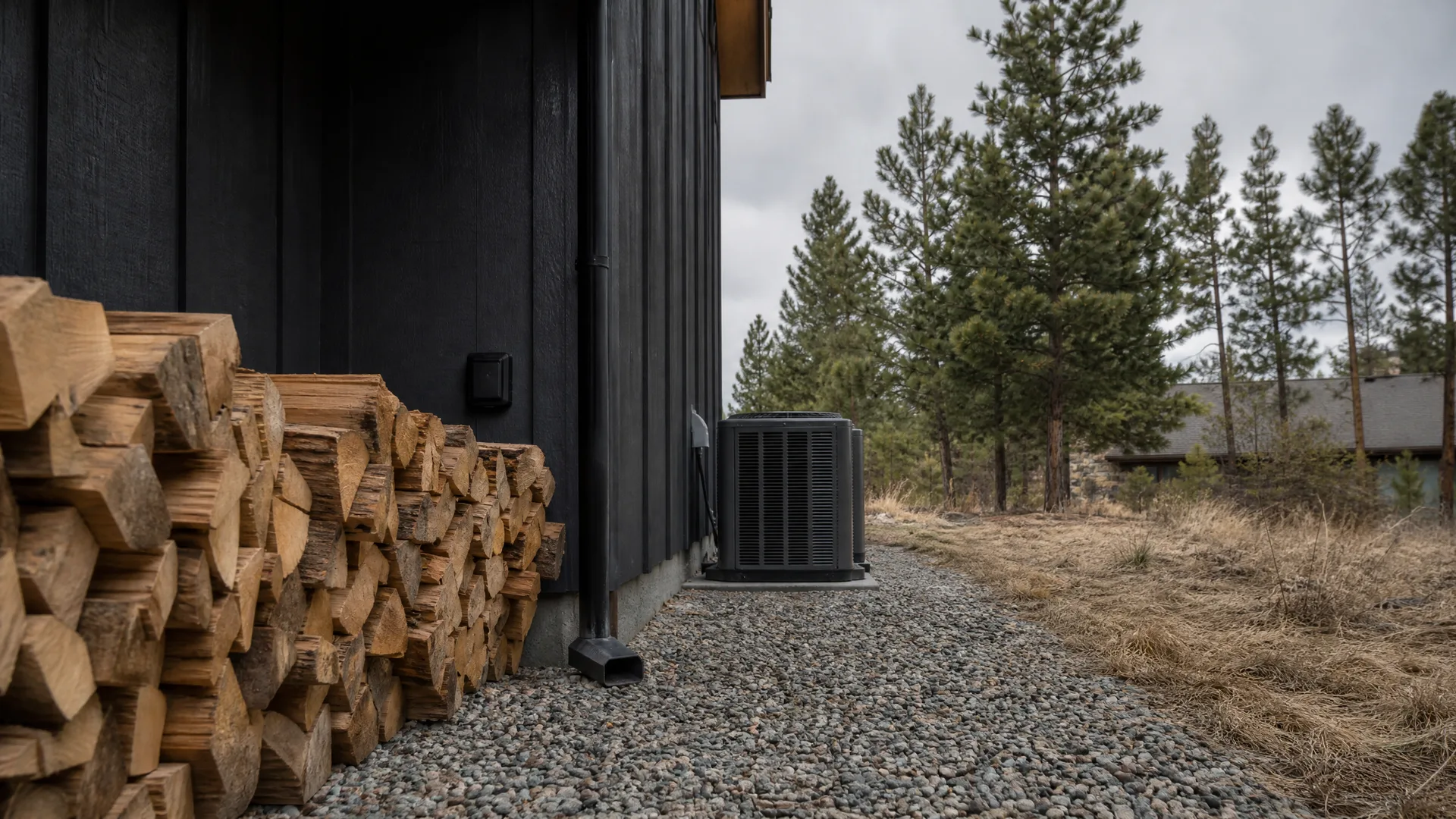
A stack of split firewood beside a dark vertical-board house wall, with an outdoor air conditioning condenser unit on a gravel path and pine trees under an overcast sky.

AC Maintenance in Steamboat Springs, CO

Tell us about the job

Takes about a minute. No obligation.

Tune-up, service, or cleaningCentral ACRoutt County, CO
Step 1 of 2

What ZIP code is the job in?

Check the filter yourself

A dirty filter is the one thing a homeowner can catch before it causes trouble. Pull it out and hold it up to a light. If you can't see light through it, swap it. A clogged filter starves the system of airflow, which makes the coil run colder than it should and can ice it over.


Know what to leave alone

The refrigerant charge, the capacitor, the contactor, none of that is a homeowner job. Opening the cabinet without the power locked out is a real shock risk, and a refrigerant line fitting is easy to damage and expensive to fix. Keep the area around the outdoor unit clear of leaves and debris, and leave the inside of the cabinet to a contractor.

74°F
the average summer afternoon it cools against
47 wind events
in ten years, and wind drives debris into outdoor units
Isometric cutaway illustration of a small home interior with furniture and ducting, showing an indoor air handler connected by lines to an outdoor condenser unit on a pad.
Your air conditioner works hardest from July through July.

NOAA nClimDiv, 1991–2020 normals

Your air conditioner only has to answer to a 74 degree afternoon in July.

That light a workload means a yearly check usually keeps it running, instead of ending it.

Steamboat sees 250 severe weather events a decade, and your outdoor unit sits right in it

250 severe weather events from 2015 to 2024
13% of homes statewide lost power a day or more in 2024
47 damaging wind events from 2015 to 2024

The filter, the coil and the drain line all work together, and a problem in one shows up in another. A clogged filter cuts the airflow moving across the indoor coil, and a coil that isn't getting enough air can drop below freezing and ice over, even on a hot day. Once that ice melts, it can overwhelm the drain pan and send water where it shouldn't go. The coil itself collects dust no matter how clean the filter is, just more slowly, and a layer of dust across the fins acts like a blanket, holding heat against the coil instead of letting it release. The drain line grows algae over time the same way a fish tank does, and that buildup narrows the pipe until it backs up. Each part is simple on its own, but a system only runs well when all three are doing their job at once.

Light duty is still worth checking once a year

A 74 degree afternoon in July doesn't ask much of this system. That's the reason a yearly check is usually enough to keep it running for years instead of needing a replacement. Get it looked at before next summer's first hot stretch.

Find a contractor
A man in a dark shirt and tan cargo pants carries a canvas and leather duffel bag up wooden porch steps toward a red front door, with a potted shrub in a red planter beside the entry.
An outdoor air conditioning condenser unit mounted on a concrete pad surrounded by gravel, photographed against a partly cloudy blue sky.

A newer system still needs the yearly check

Half the homes in this county were built in 1993 or later. If yours is one of them, the air conditioner may still be the original unit, or close to it, well inside the years it should last. A yearly check is what keeps a system that age from losing ground: a contractor catches a weak connection or a coil that's starting to lose efficiency while it's still a small fix. Skip it for a few years and the same system ages faster than it has to, light workload or not.

The readings only a gauge can catch

A system can still blow cold air while running low on refrigerant or pulling too much current through a weak capacitor. None of that shows up as a sound or a smell. A contractor hooks up gauges to check the pressure, checks the capacitor's output against its rating, and checks the amp draw on the compressor. Those numbers catch a problem while the system is still cooling fine, not after it stops.

What's happening inside the cabinet

The coil can lose airflow to a layer of dust so thin you would not notice looking at it, and a drain line can grow a clog that backs water up into the pan. A contractor pulls the panel, looks at the coil fins directly, and runs water through the drain to make sure it clears. These are spots inside the cabinet a homeowner never opens up, which is exactly why they're worth having checked.

A quick tune-up is a filter check and a glance at the outdoor unit. A thorough one takes a lot longer, because the contractor is opening the cabinet and testing things that don't show up from the outside. Washing the coil with a real cleaner and a brush is different from a quick rinse with a hose, and only one of those gets through the dust packed between the fins. The condensate drain should get flushed, not just looked at, since a clog can sit further down the line than eyes can follow. A capacitor reads a number on a meter, and that number either matches its rating or it doesn't. If a contractor is in and out in a few minutes, they checked the filter and little else.

A tune-up starts outside, at the disconnect. Power gets shut off before anything else happens, because the capacitor can hold a charge even with the system off. From there a contractor pulls the panel and looks at the wiring, checking each connection for a loose terminal or a spot where the insulation has started to wear through. The contactor gets checked too, since its contacts pit and burn a little every time the compressor cycles on, and a badly pitted one will eventually fail to make contact at all. The fan motor and compressor both get an amp reading while running, compared against what the nameplate says they should draw. A motor pulling more current than it should is working harder than it needs to, usually because a bearing is going or the capacitor behind it is weakening. None of this takes long to check, but skipping it means the first sign of trouble is the system not starting at all.