Mini split not heating in Thornton, CO
Find my proA mini split that won't heat in a Thornton winter isn't something to sit on. Below freezing is normal here for months, and a unit blowing cold or not kicking on at all leaves a room with no backup plan if it's the only heat source. The cause could be a stuck defrost cycle, a refrigerant leak, a bad sensor, or something with the outdoor unit icing over and not clearing. Guessing at it from indoors doesn't tell you much. What helps is getting a local contractor who works on mini splits all winter, in homes dealing with the same cold snaps as yours, looking at the actual unit. Answer a few questions about your system and your heating problem, and you'll be matched with one licensed contractor local to the Thornton area, not a handful of companies bidding for your attention. They'll reach out directly to look at next steps for your situation.
Why is my mini split not heating in the winter?
Your mini split is running but the air coming out isn't warm, or it won't turn on at all now that temperatures have dropped. In Thornton, that's a problem the first cold snap makes obvious, especially if the unit is the only heat in a converted garage, sunroom or addition. Most mini splits here handle winter fine, so when one stops keeping up, something specific has gone wrong with it.
Usually a frozen or dirty outdoor coil, a refrigerant leak, or a defrost control that isn't cycling right
A mini split pulls heat from the outside air even when that air is cold, and the outdoor unit depends on a clean coil and a working defrost cycle to do it. When the coil ices over and the defrost cycle doesn't clear it, the system loses its ability to pull in heat and the indoor head blows cool air instead of warm. A low refrigerant charge does the same thing by making the system work harder for less heat. Thornton winters put units through long stretches below freezing, so a defrost control or coil problem that would barely show up in a mild climate gets forced into the open here. If the outdoor unit is caked in ice or frost that won't melt off between cycles, that's usually where the problem sits.




What are you noticing in the room right now
The room with the mini split feels the same temperature as the hallway, or colder. You might hear the unit running, the fan audible, but nothing warm comes out of the vent. Maybe it short cycles, kicking on for a minute and shutting off again. Some units show a blinking light on the indoor head or a code on the small display, which is the unit telling you something specific if you know where to look. If this is the only heat in that room, a bedroom addition or a converted garage, the people using that space are the ones who feel it first, and pipes or anything stored in there have no protection once the room drops toward outside temperature.
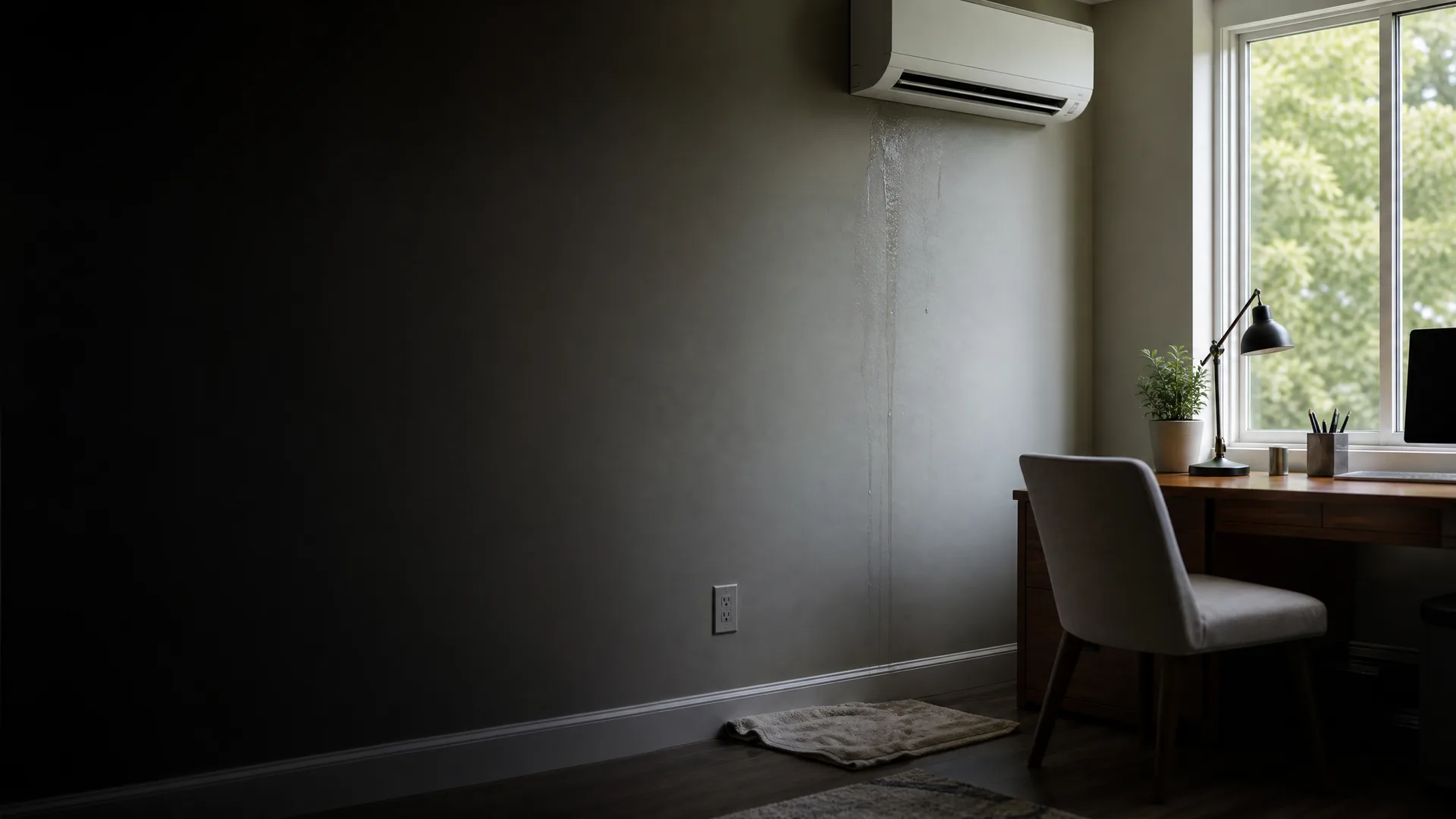
You're at the desk in the home office, working through the afternoon, when you notice the wall under the mini split looks dark. A streak has run down from the unit, soaking into the paint. By the time you pull a towel over to catch it, there's already a small puddle on the floor. Outside it's a hot, dry Adams County afternoon, the kind where this unit should be running nonstop. Instead the line set is sweating or the drain's backed up somewhere inside the wall, and water is finding its way out the only path it has, straight down your wall.


Summer here doesn't feel as heavy as it looks on paper, with dew points averaging 44°F across June, July and August in Adams County, NOAA data shows. That's dry air, and it matters for a mini split because the same outdoor unit pulling heat from winter air is pulling moisture out of summer air the rest of the year. A coil that stays dry through a dry summer still has to work hard once temperatures drop below freezing, and if it's already struggling with ice or a dirty coil going into winter, the dry summer wasn't the problem. A local tech who services these units through both seasons knows which failures show up after a Front Range summer and which ones are purely a winter cold snap. When you're matched with a contractor, it's one who works on mini splits year-round here, not a dispatcher sending whoever's free.
NASA POWER T2MDEW
Get matched with a mini split pro in Adams County
A mini split that's lost its heat in January doesn't fix itself by waiting it out. Most units here are set up to handle Thornton winters down into the single digits, so when one stops pulling warmth from outside air, something specific has gone wrong, not the system in general giving out. Low refrigerant, a failing defrost sensor, a reversing valve stuck in the wrong position, an outdoor coil iced over and not clearing itself, these each show up a little differently, and a tech who works on these units all season in Adams County has likely already seen your version of it this month. Getting matched means one local contractor looks at what your unit is actually doing, not a guess made over the phone. With a hard freeze still ahead most weeks, a room running on a mini split with no backup heat isn't one to leave half-working while you wait to see if it gets worse.
What a Cold Mini Split Means
- A mini split blowing cold air in a Thornton winter almost always traces back to one specific part, not the whole unit.
- Running the system without heat during a hard freeze risks a frozen or cracked line, which turns a repair into a bigger job.
- A technician who works on mini splits through Adams County winters has seen which parts fail first in this cold and checks those before anything else.
- Matching with one licensed local contractor means a single visit from someone who knows the equipment, not a string of calls to field.
- The outdoor unit, the refrigerant charge and the defrost cycle each point to a different fix, and the right one depends on what's actually happening at your wall unit.
- Getting it looked at before the next cold snap means you're not choosing between a cold room and a bigger repair bill later.
A mini split that won't heat in a Thornton winter is pointing at something specific. It might be the outdoor unit struggling to pull warmth from air that's below freezing, a refrigerant charge that's dropped low, or a defrost cycle that's stuck and never switching back to heat mode. Each of those looks a little different at the wall unit, whether it's cold air blowing steady, short cycling, or no response at all. That's why guessing at a fix from the couch doesn't get you far, and why running the system as is through a hard freeze isn't worth the risk to the line set.
What helps is someone who's already seen this particular failure this particular winter, in homes not far from yours. A contractor working mini splits across Adams County through January and February knows which part tends to go first in this cold, and starts there instead of working through the whole unit piece by piece. You get matched with one licensed local contractor, so it's a single visit from someone who already has a sense of what they're walking into, not a handful of callbacks while different companies take a swing at it.
The room isn't going to warm up on its own, and the unit isn't going to reset itself. What changes things is getting the actual cause in front of someone who knows this equipment, before the next cold snap makes the problem worse than it is right now.

Mini Split Repair
Find a mini split repair pro in Adams County

- Get matched with someone who does this kind of work in Adams County.
- Get matched with a pro who fixes mini splits in Adams County.

- After this form, you can stop searching for a mini split pro.
- One request and the search for a pro is handled.

- Explain the mini split problem once instead of to every shop in Adams County.
- Explain the job once and skip repeating it on every call.

- The pro who gets in touch is licensed in Colorado and works in Adams County.
- Your request goes to one pro, not a list of companies.