A lit mountain lodge-style home at night with evergreen trees, stone accents, and snow-capped mountains in the background.

Mini Split Installation in Trinidad, CO

Tell us about the job

Takes about a minute. No obligation.

New system or replacementMini-splitLas Animas County, CO
Step 1 of 2

What ZIP code is the job in?

Gas heat is the default here

Utility gas heats 48.5% of homes in Las Animas County, more than any other fuel. Another 23.8% run on bottled or LP gas. A mini split going into a home like that is usually there to add cooling or to cover one room, not to replace the furnace.

What this means for the install

If your home already has gas heat, the mini split has a narrower job. It might cool a room the ducted system struggles to reach, or cover a space that got added on later. That changes where the contractor places the indoor unit and how many zones the job needs.

8 months
October through May, your system heats
3 months
June through August, it cools
20°F
the average winter night it heats against
86°F
the average summer afternoon it cools against
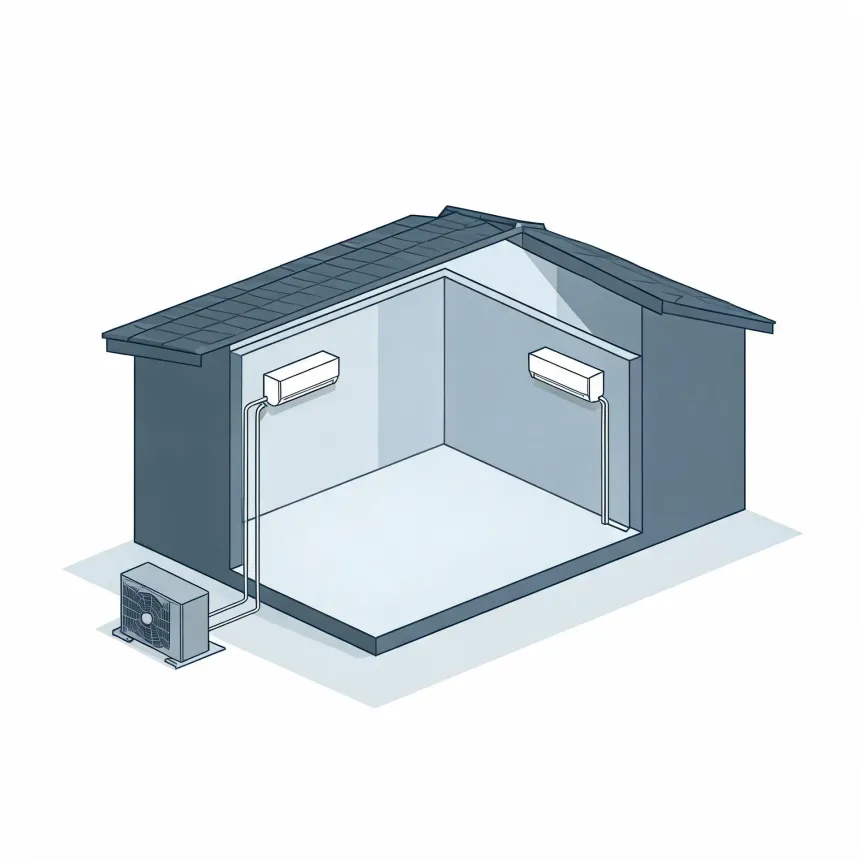
Cutaway isometric illustration of a small building interior showing two wall-mounted indoor air conditioning units connected by line sets running down to a single outdoor condenser unit on the ground outside.
Your system heats October through May and cools June through August.

NOAA nClimDiv, 1991–2020 normals

Summer here runs June through August, with afternoon highs averaging 86°F.

A standard mini split handles that fine, no need to size up or pay for extra capacity it won't use.

Get it in before June, while you can still pick the day

Cooling runs June through August
Summer afternoons average 86°F
151 damaging wind events from 2015 to 2024

Trinidad sits in climate zone 4B, a dry zone that still asks real work of both the heating and cooling side. Any mini split going in has to meet the federal minimum for a split-system heat pump, which is 14.3 SEER2 for cooling and 7.5 HSPF2 for heating. That rule applies whether the unit is ducted or ductless. There's no separate, looser standard for a ductless system. A contractor quoting the job should be working from those two numbers, not something lower. Beyond the minimum, a federal tax credit is available for qualifying heat pump installations, worth checking against whatever unit gets proposed.

A standard mini split is the right call here

Las Animas County sees its share of rough weather, winter storms most of all, 166 of them in the past decade. None of that changes what a mini split needs to be here. A standard size and efficiency rating handles the heat and the cold without upsizing. Nothing about this county asks for more than that.

Find a contractor
A man in a cap, gray shirt and tan work pants, seen from behind, carries a canvas tool bag up stone steps toward a red front door, with a potted plant beside the entry.
A white outdoor air conditioner condenser unit mounted on metal wall brackets against gray horizontal siding, with a blue sky and white clouds behind it.

An older house, a newer system

Half the homes in Las Animas County were built in 1972 or earlier. A house that age wasn't built with a mini split in mind, and whatever is already on the wall or run through the attic is whatever that house happens to have. A contractor sizing the job needs to see the actual space before settling on where the line set runs and where the indoor unit goes. None of that shows up in a quote done over the phone.

The indoor unit and outdoor unit are a matched pair

A mini split's price isn't just the equipment, it's what has to happen to put it in. The line set running between the indoor head and the outdoor condenser has to be cut, run, and brazed on site, then checked for leaks before anything gets charged with refrigerant. A straight run through an exterior wall costs less labor than one that has to go up through an attic or around framing to reach where the indoor unit makes sense.

Where the condenser sits matters

The outdoor unit needs a flat, stable pad or mount, clearance on all sides for airflow, and a path for the electrical whip back to a disconnect and breaker. If the panel doesn't have an open slot for a new circuit, that's extra work before the mini split itself goes in. None of this shows up on a price list, it shows up when someone looks at the actual wall and the actual panel.

When you're comparing quotes, ask each contractor what SEER2 and HSPF2 numbers they're actually quoting, not just the brand and model. Ask how many indoor heads the system supports and whether that matches the number of rooms or zones you need covered. Ask where they plan to run the line set and mount the outdoor unit, since that changes the labor more than the equipment does. Ask whether your electrical panel has room for the new circuit or whether that's a separate cost. A contractor who's actually planned the job can answer all of that without hedging. One who can't has only priced the box, not the install.

Installation day starts with the line set, not the equipment. The contractor mounts a bracket for the indoor head, cores a hole through the wall at a slight downward slope to the outside, and feeds the line set, drain line, and control wiring through together. Outside, the condenser goes on its pad or wall bracket, and the lines get connected and brazed at both ends, a joint that has to be done with the right torch and filler or it won't hold pressure. Before any refrigerant moves, the whole system gets pulled down to a vacuum to pull out moisture and air, and a good contractor holds that vacuum and watches the gauge rather than rushing to charge it. Only after that does the system get charged, usually to a factory charge adjusted for line length, and run through its paces, heat and cool, to check the temperature split at the indoor head. The last part of the day is the electrical, tying the outdoor unit to its own breaker and disconnect, not sharing a circuit with something else in the house.