Most homes here run on gas
57.3% of occupied homes in Logan County heat with utility gas. Another 17.1% use bottled or LP gas. A mini split adds cooling and zoned heat without touching that system.
Takes about a minute. No obligation.
57.3% of occupied homes in Logan County heat with utility gas. Another 17.1% use bottled or LP gas. A mini split adds cooling and zoned heat without touching that system.
For a home already heated by a furnace or boiler, a mini split handles a room or two the main system doesn't reach well, and covers summer cooling on its own.
NOAA nClimDiv, 1991–2020 normals
The efficiency number on a mini split is a ratio, not a size.
A high rating on an undersized unit still leaves a room that won't cool, so the rating only matters once the unit is matched to the space.




Logan County sits in climate zone 5B, a cool, dry zone where heating carries more of the load than cooling. Any mini split installed here has to meet the federal minimum for that equipment class, since the standard treats a ductless heat pump as a split system rather than its own category. For units made from 2023 onward, that means at least 14.3 SEER2 for cooling and 7.5 HSPF2 for heating. Those numbers set a floor, not a target, so a contractor sizing a system for this climate is already working above them. A mini split that clears the federal minimum may also qualify for the federal energy efficiency tax credit, worth checking before you settle on a unit.
A mini split sized to the room, at the efficiency floor the federal standard already sets for this zone, costs more to run only through what you pay per kilowatt-hour. Colorado homes paid 14.92 cents in 2024. There's no local reason to size up or pay for a higher-end unit than the space calls for.
Find a contractorCooling here runs June through August, three months. If you're installing before summer, May is the month to get it done. A contractor can size the unit, run the line set and get the system charged without the pressure of a hot week already underway. Wait until June and you're scheduling around whatever else is going on with everyone else's system at the same time.
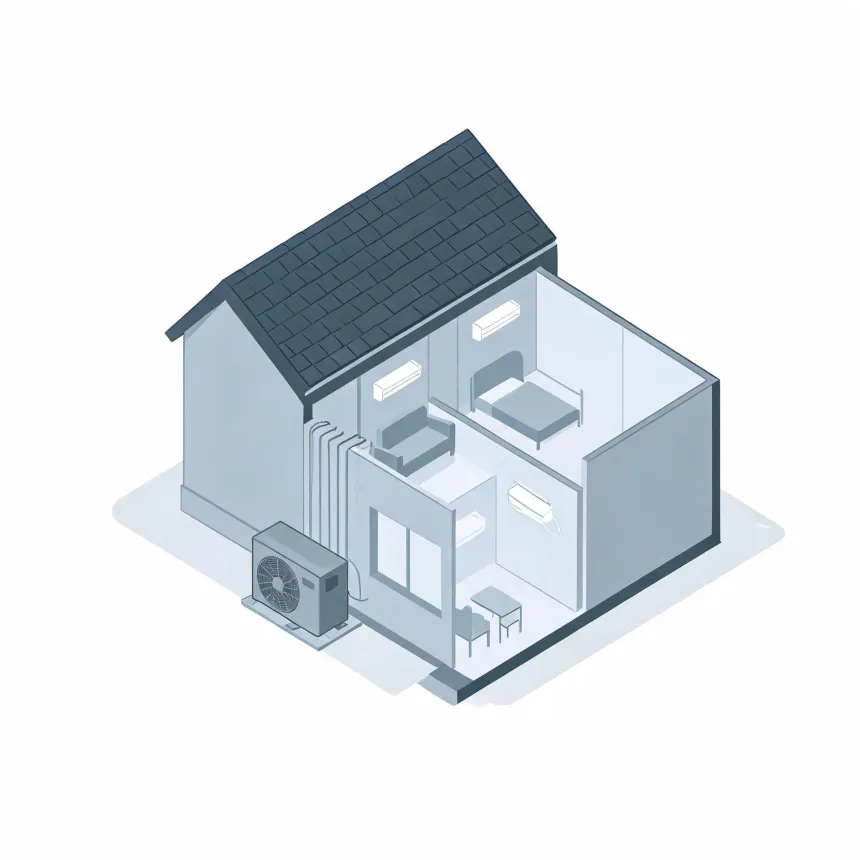
The indoor head and outdoor unit connect through a line set that carries refrigerant between them. A short, straight run costs less in time and material than one that has to go up an exterior wall, around corners, or through framing to reach the other side of the house. A contractor walks the inside and outside of the house before quoting, because where the outdoor unit can sit and where the indoor head makes sense to mount decides how much line set the job needs.
One indoor head tied to one outdoor unit is the simplest version of this install. Add zones and the job adds a line set run and an indoor head for each one, plus an outdoor unit built to run them together. Sizing gets harder too, since every head has to match the room it serves without leaning on the others to make up the difference.
Sizing a mini split starts with the room, not the brochure. A contractor works out how much heat the space gains in summer and loses in winter, using the square footage, the ceiling height, how many windows it has and which way they face, and whether the room sits under an attic or shares walls with the rest of the house. That load is what the unit has to match. Too big and it cools the room fast, shuts off, and leaves the air clammy because it never ran long enough to pull moisture out. Too small and it runs constantly, straining to hold a temperature it can't quite reach, and wears out faster for the work it's doing. The right size is the one that runs long, steady cycles and holds the room without strain in either direction.
Installation starts with the walk-through the contractor already did to quote the job, so day one is about putting that plan into the house. The outdoor unit goes on a pad or wall bracket, leveled so condensate drains the way it should. Indoors, the mounting plate goes up first, then the line set, drain line and power wire run through a single hole drilled behind the head, usually no bigger around than a soda can. That hole gets sealed from both sides once the lines pass through, since any gap there is a path for outside air. The line set gets connected at both ends, then the system is pulled down to a vacuum to clear out air and moisture before any refrigerant moves through it. Skip that step and moisture left in the lines turns to acid over time and eats at the compressor. Once the vacuum holds, the system gets charged, the head gets tested on both heating and cooling, and the contractor checks that it's pulling the temperature down or up at a normal rate before calling the job done.