Illuminated timber-frame and stone houses along a residential street at night, with snow-capped mountains visible in the background.

Mini Split Installation in Steamboat Springs, CO

Tell us about the job

Takes about a minute. No obligation.

New system or replacementMini-splitRoutt County, CO
Step 1 of 2

What ZIP code is the job in?

Gas heats most homes here

Utility gas heats 45.6% of homes in Routt County, more than any other fuel. Electricity is next at 30.8%, and propane heats another 16.2%. A mini split adds cooling or targeted heat without touching the furnace or boiler already in place.

What that means for the install

If gas or propane handles the main heat, a mini split's job is usually to cool rooms that don't get airflow, or to heat a space like a bonus room or garage on its own. The contractor sizing the system needs to know what's already there and what this unit is meant to cover.

10 months
September through June, your system heats
11°F
the average winter night it heats against
74°F
the average summer afternoon it cools against
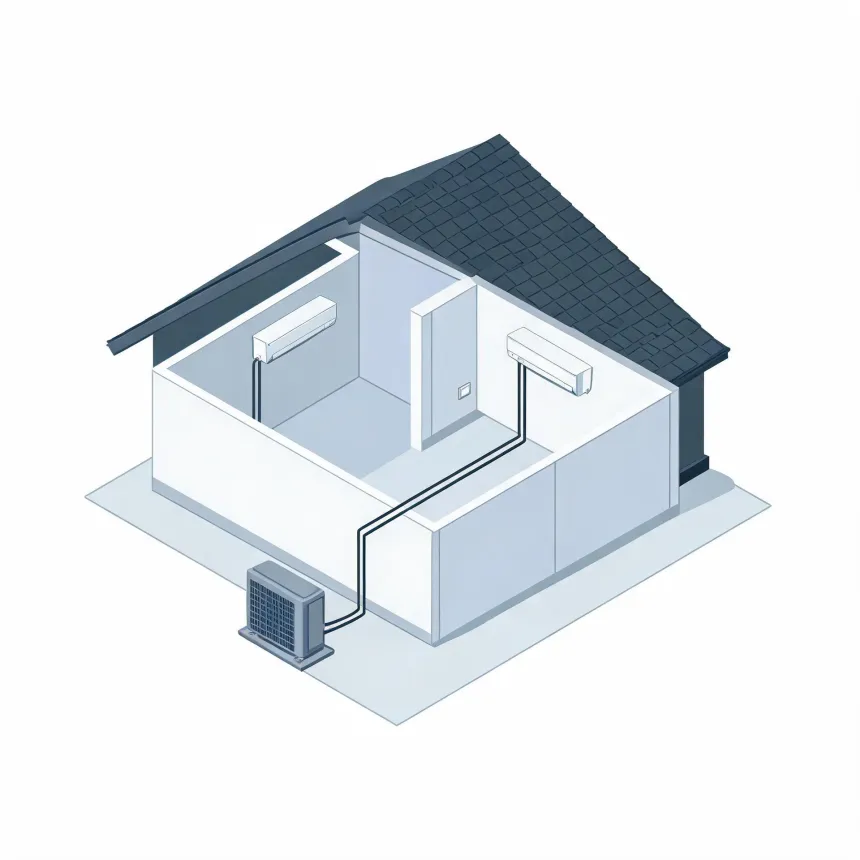
Isometric cutaway illustration of a small house with a dark shingled roof, showing two wall-mounted indoor air conditioning units in separate rooms connected by lines to an outdoor condenser unit on the ground outside.

Colorado electricity runs 14.92 cents per kilowatt-hour, below the national average.

A high-efficiency mini split still costs less to run here, but the payback on the top-tier model takes longer, so matching the unit to the room matters more than chasing the highest SEER2 number.

Cool summers mean less strain on the system

Summer afternoons average 74°F
47 damaging wind events from 2015 to 2024
Power costs 14.92 cents a kWh statewide

With power this cheap, the size of the unit matters more than its efficiency rating. A mini split that's too big for the room cycles on and off and never settles into a steady, efficient run. One that's sized right for the square footage it covers will hold a steady temperature and cost less to run than a higher-SEER2 unit that's the wrong size. Tell the contractor the exact room or space this needs to handle, not just the system you want. That's what sizing comes down to here, not the spec sheet.

Reliability first

Power is cheaper here, so the most efficient model takes longer to pay off. Reliability and fit matter more.

Find a contractor
A white outdoor air conditioner condenser unit mounted on metal wall brackets against gray horizontal siding, with a blue sky and white clouds behind it.

Ask about the install, not just the unit

A mini split that runs for years without a callback usually comes down to questions asked before it went in, not after. Ask how many zones one outdoor unit will carry, and what happens to the whole system if one indoor head needs service. Ask about the line set length and how many bends it needs to reach where the outdoor unit can actually sit, since a longer run or extra joints changes how the system performs. Ask what the manufacturer's warranty actually covers versus what the installer covers, and whether that warranty requires proof of annual maintenance. Ask how the contractor sizes a unit for a room, not just the square footage but the ceiling height, the windows, and what's on the other side of the walls. A unit sized off a quick guess runs short cycles for as long as it's installed. Ask what the sound rating is for the indoor head if it's going in a bedroom. None of this shows up on a spec sheet, and all of it decides whether the system is still running well years from now.

The old system usually stays

A mini split doesn't replace a furnace or boiler. If the existing system heats the home, it keeps running, and the mini split works alongside it. There's no old equipment to haul away unless the job is swapping out an existing mini split or window unit.

Swapping an old mini split is different

If this install is replacing a failed mini split, the old indoor head and outdoor unit come out, and the line set gets checked rather than reused. Old refrigerant lines can have the wrong diameter or old residue in them, so most contractors run new line set rather than tie into what's already there.

Sizing a mini split starts with a heat loss and heat gain calculation for the specific room, not a rule of thumb about square footage. A contractor walks the space and accounts for ceiling height, the number and size of windows, which walls face outside, and what insulation separates that room from the attic or the garage next door. Skip that work and the unit gets picked off a chart, and a chart doesn't know this room has a wall of west-facing glass or backs up to an unheated space. Too big and the compressor fires, blasts the room to temperature, and shuts off before it ever removes the moisture from the air, so the space feels cold and damp rather than comfortable. Too small and it runs flat out all day and still can't keep up when the temperature swings. The right size holds a steady output and a steady temperature, and that steady run is what keeps the compressor lasting as long as it's built to.

Price moves with everything that happens before the unit ever turns on. The outdoor unit needs clearance on all sides and a clear path back to the indoor head, and if that path runs through framing, brick, or a finished ceiling, cutting it costs more than running it along an open wall. Line set length and the number of bends add to the labor, since every joint has to be flared and tested for leaks before the system gets charged with refrigerant. A dedicated electrical circuit is often part of the job, and whether the panel already has room for it or needs new breaker space changes the scope. A multi-zone system costs more than a single head because each indoor unit needs its own line set and its own mounting work, even running off one outdoor compressor. None of this shows up on the price tag of the unit itself, which is why the same mini split can come with very different installation costs depending on the house it's going into.