A tabby cat sleeps on a dark quilted bed in a moody, minimalist bedroom with a black wall-mounted air conditioning unit.

Mini Split Installation in Salida, CO

Tell us about the job

Takes about a minute. No obligation.

New system or replacementMini-splitChaffee County, CO
Step 1 of 2

What ZIP code is the job in?

Gas heats most homes here

Utility gas heats 44.8% of occupied homes in Chaffee County, and another 26.4% run on bottled or LP gas. Electric heat accounts for 18.0%. A mini split is rarely replacing an existing one here, it's usually going in alongside a furnace.

That changes what the install has to do

If your home heats with gas or propane, a mini split is most likely going in to cover cooling, or to handle one room the furnace doesn't reach well. The contractor needs to know what's already there before sizing the new system.

9°F
the average winter night it heats against
71°F
the average summer afternoon it cools against
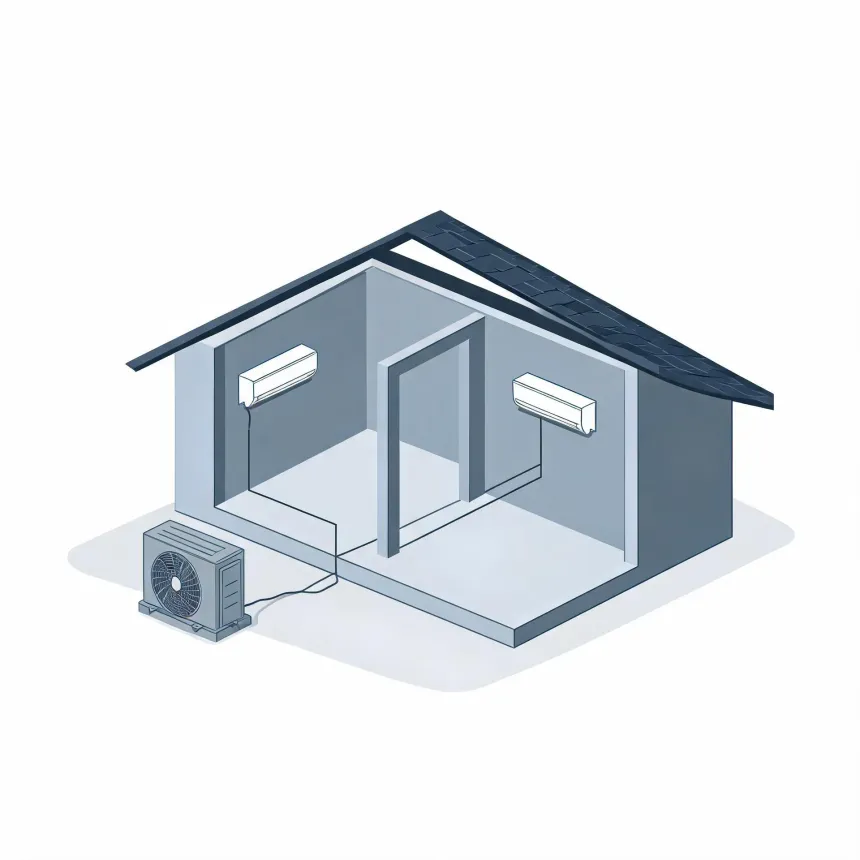
Isometric illustration of a cutaway house showing two wall-mounted indoor air conditioning units connected by lines to a single outdoor condenser unit on the ground outside.

Colorado electricity ran 14.92 cents per kilowatt-hour in 2024.

At that rate a mini split earns its keep on comfort first, the power bill second.

Winter here is the real test, not the heat

236 severe weather events from 2015 to 2024
13% of homes statewide lost power a day or more in 2024
72 damaging wind events from 2015 to 2024
Barely any cooling load to speak ofSummer afternoons in Chaffee County average 71°F, so a mini split here almost never runs for cooling.

Chaffee County sits in climate zone 6B, cold with dry air and winters that run long. Any ductless system installed here has to meet the federal minimum for split-system heat pumps, 14.3 SEER2 for cooling and 7.5 HSPF2 for heating. The standard doesn't carve out a separate rule for ductless equipment, so a mini split has to clear the same bar as a ducted heat pump. That rules out older or stripped-down units that can't hold up through a winter this cold. A system that meets this standard can also qualify for a federal tax credit, worth looking into before you buy. Ask a contractor to show you the SEER2 and HSPF2 ratings on anything they quote, not just the brand name.

Pick the mini split that fits the room, not the one with the lowest power bill

Get a contractor to size the system for the room it needs to cover and the winters it has to run through. With power this cheap, the payback on a higher SEER2 number is slow, so pick the unit that will hold up and heat well, not the one with the best efficiency rating.

Find a contractor
A man in a cap, dark shirt and tan work pants, seen from behind, climbs porch steps toward a red front door while carrying a canvas tool bag filled with screwdrivers.
A beige split-system air conditioner outdoor condenser unit mounted on metal wall brackets atop a stucco wall.

The old furnace doesn't go away, it just works less

A furnace this old system might be paired with cycles on and off as the house calls for heat. A mini split doesn't retire that system, it just takes some of the load off it. What happens to the furnace depends on how the mini split gets used. If it's covering one room full time, that's a room the furnace no longer has to fight for, and the furnace's own runtime drops a little. If the mini split is handling shoulder season on its own, the furnace might sit idle for weeks at a stretch before it has to carry the coldest part of winter alone. Either way, the furnace stays the backup for the hardest days, so it still needs its own yearly service, the burner checked, the heat exchanger inspected, the filter changed. An old system doesn't fail less often just because it's running less. It fails on its own schedule, usually at the igniter, the flame sensor or the inducer motor, and that clock doesn't reset just because a mini split is doing more of the work now.

The outdoor unit and the indoor head aren't the whole job

The line set has to run between them, carrying refrigerant through a wall and however far the outdoor unit sits from the room. A short, straight run is simple. A run that has to go up through a chase, around framing, or across a longer distance takes more line, more labor, and more care brazing those joints so the system holds its charge.

Where the condensate drains matters

A mini split pulls moisture out of the air and that water has to go somewhere. If gravity can carry it out and away, that's a simple drain line. If the indoor head sits somewhere the drain has to run uphill, the job needs a small pump to move that water out, and that pump is one more part to install and wire in.

Sizing a mini split starts with a heat loss calculation on the room, not a guess based on square footage. A contractor measures the walls, the windows, the insulation, and works out how much heat that room loses on the coldest day it sees. Get the size wrong and the system fights itself both ways. Too big, and the unit short cycles, reaching setpoint fast and shutting off before it's pulled any moisture out of the air, so the room feels clammy even at the right temperature. Too small, and it runs flat out all winter and still can't keep up when it's coldest, which is exactly when you need it most. Capacity also isn't fixed. A heat pump puts out less heat as the outdoor temperature drops, so the unit has to be sized against its output in the cold, not its rated output at a mild setpoint.

Installation starts with where the lines go, not with unboxing equipment. The outdoor unit needs a spot with clearance for airflow, close enough to the wall penetration that the line set run stays manageable. Once that's picked, the crew cores a hole through the wall for the line set, the drain, and the electrical whip, then mounts the bracket for the indoor head and gets it level before anything else happens. Brazing the refrigerant line joints comes next, and that connection has to be done right and pressure tested, because a slow leak there won't show up as a problem until months later when the system can't hold its charge. Once the lines are connected, the system gets vacuumed down to pull out moisture and air, then charged with refrigerant and run through its paces, heating and cooling, before anyone calls it done. Expect the crew to spend as much time on the lines, the drain, and the electrical as they do mounting the equipment itself.