





A lit mountain lodge-style home at night with evergreen trees, stone accents, and snow-capped mountains in the background.

Mini Split Installation in Rifle, CO

Tell us about the job

Takes about a minute. No obligation.

New system or replacementMini-splitGarfield County, CO
Step 1 of 2

What ZIP code is the job in?

Most homes in Garfield County heat with utility gas, 64.8 percent. A mini split runs on electricity instead, and it handles both heating and cooling from the same unit. That makes it a different kind of job than swapping one gas furnace for another. Some homeowners add a mini split to cover a room the furnace does not reach well, like a bonus room or a converted garage. Others are moving away from gas and want one system that does both jobs year round. Either way, it helps to know going in that you are changing fuel type, not just equipment.

10 months
September through June, your system heats
16°F
the average winter night it heats against
77°F
the average summer afternoon it cools against
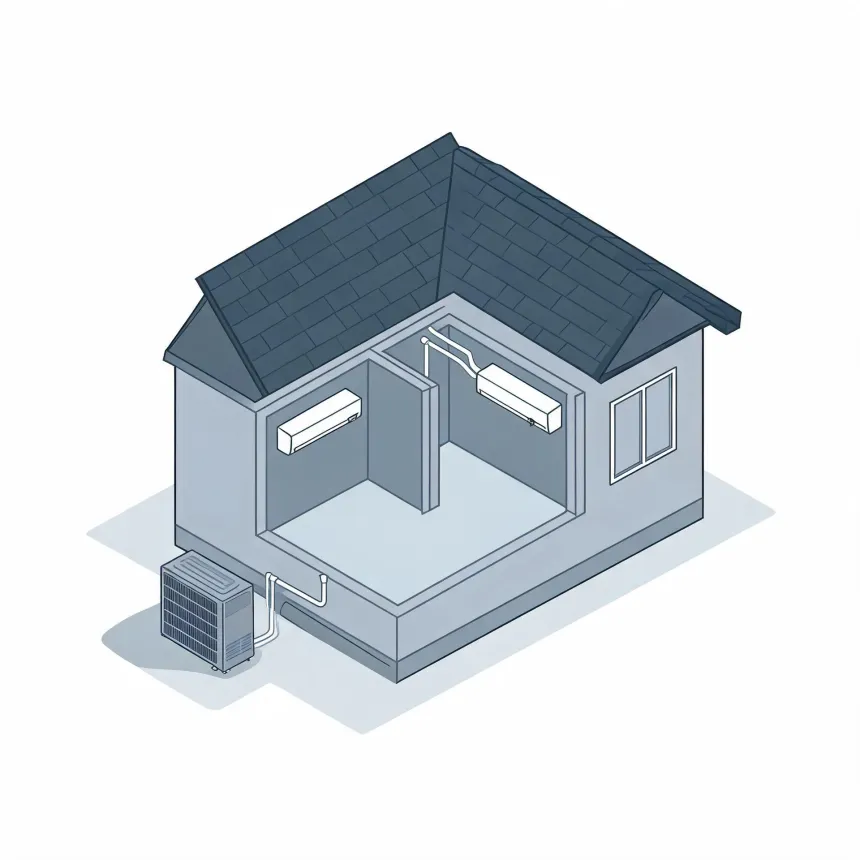
Isometric line illustration of a cutaway house with a shingled gable roof, showing two wall-mounted indoor air conditioning units connected by piping to an outdoor condenser unit on the ground outside.

Electricity in Colorado ran 14.92 cents a kilowatt-hour in 2024, below what a lot of the country pays.

The top-efficiency mini split still costs more upfront, and here it takes longer to earn that back, so pick the unit that fits the room and lasts, not just the one with the best rating.

Weather here is normal for a mini split. Size it for the room, not the storms.

405 severe weather events from 2015 to 2024
13% of homes statewide lost power a day or more in 2024
144 damaging wind events from 2015 to 2024
Pick a reliable mini split, not the top-efficiency oneAfternoons average 77°F in summer here, so the outdoor unit never has to work hard.

Rifle sits in climate zone 5B, where winters drive the load and the federal rules are stricter about it. A ductless mini split falls under the same federal standard as any other split-system heat pump, so one installed new has to hit at least 14.3 SEER2 for cooling and 7.5 HSPF2 for heating. There's no separate, looser rule for ductless. That narrows the field some, but it also means whatever gets installed will handle the heating load this zone expects of it. A system bought now may also qualify for the federal tax credit, which is worth checking before you settle on a unit.

Pick the unit that fits the room, not the top rating

Summers here top out around 77°F, so the compressor is rarely working hard. That means a reliable mini split sized right for the room will hold up fine, you don't need to pay extra for the highest efficiency rating on the shelf.

Find a contractor
A man in a cap, dark shirt and brown work pants walks up porch steps toward a red door, carrying a worn canvas tool bag, with a potted shrub in a red planter beside him.
A beige split-system air conditioner outdoor condenser unit mounted on metal wall brackets atop a stucco wall.

Ask how it behaves at low load, not just full load

A mini split spends most of its life at part load, not full blast, so ask how well each system handles that. Inverter-driven compressors ramp up and down to match the room, where older single-speed units just cycle on and off at full power. That cycling is what wears a system out faster, and it's also what makes a room feel too hot, then too cold. Ask what turndown ratio the compressor has, meaning how low it can throttle itself. A unit that can run low and steady for hours will rack up fewer start-stop cycles over its life than one that keeps shutting off and kicking back on. Ask too about the outdoor unit's low-ambient operation, since that's what decides how it behaves on the coldest mornings, not just how it's rated on a mild day. Over years of running, those differences in how a system behaves at low load matter more than the number on the spec sheet.

Sizing comes from a room by room heat loss and heat gain calculation

A contractor measures each room's windows, walls, and exposure to work out how much heat it loses in winter and gains in summer. That number, not the square footage alone, decides which indoor unit goes where and what capacity it needs. Skip this step and the installer is just guessing.
Oversized or undersized both cause problems, just different ones

A unit too big for the room cools or heats it fast, then shuts off, so it cycles on and off all day and never pulls the humidity down. A unit too small runs constantly and still can't keep up on the coldest or hottest days. The right size runs long and steady instead.

If the old system is a furnace paired with central air, both go away, since a mini split replaces what they did together. The furnace, the outdoor condenser and the indoor coil all come out. Ductwork is a separate question. If the ducts stay in place to feed rooms the mini split does not reach, they still need a damper or a plan so the furnace side does not fight the new system. If the house is moving to mini splits entirely, abandoned ducts should get sealed off, not just left open, or they pull conditioned air into spaces nobody is using. The gas line that fed the furnace gets capped by whoever is licensed to do it. None of this is part of hanging the new indoor and outdoor units, so ask directly who handles removal and capping before the job starts, rather than finding out partway through.

The rating on the label is measured in a lab under set conditions, not in your house. It tells you how efficiently the unit turns electricity into heat or cold at that one test point. It says nothing about how the system will behave on the coldest morning of the year or how quiet it sits in the hallway. A unit with a strong rating can still run poorly if it was sized wrong for the room, because an oversized or undersized system wastes the efficiency built into it no matter what the sticker says. Placement matters too, since a unit fighting direct sun or a bad spot on the wall works harder than the rating assumes. Treat the number as one piece of the decision, not the whole of it.