Most homes here run on gas
Utility gas heats 72.2% of occupied homes in Jefferson County. Electricity accounts for 23.2%, and LP gas another 2.4%. A furnace is the common setup here, not a heat pump.
Takes about a minute. No obligation.
Utility gas heats 72.2% of occupied homes in Jefferson County. Electricity accounts for 23.2%, and LP gas another 2.4%. A furnace is the common setup here, not a heat pump.
If gas heats your home now, a mini split in Lakewood usually goes in alongside the furnace, covering a room or zone the ductwork doesn't reach well, and handling cooling for that space too.
NOAA nClimDiv, 1991–2020 normals
Cooling in Jefferson County runs in July, and only July.
Have the mini split installed before June so it's running, not being installed, when it gets hot.



Jefferson County falls in climate zone 5B, a cool, dry zone where heating carries more of the load than cooling. A mini split installed here still has to clear the federal minimum for split-system heat pumps. That rule covers ductless systems the same as it covers ducted ones. Ask to see the unit's rating label and check it against that minimum before you settle on a model. A system that clears it will also qualify toward the federal tax credit available for heat pump installations.
That changes the math on which mini split to buy. The top-efficiency model costs more and takes longer to earn that back when power is already cheap. Picking one that clears the federal minimum, fits the room, and holds up to Lakewood winters matters more than chasing the highest rating on the label.
Find a contractorOne month of cooling. That's the whole job for a mini split's compressor side, and the afternoon high in that month averages 80. It won't run hard and it won't run long. The heating side carries more weight, same as it does for the furnace already in the house. A unit built for this doesn't need to be oversized or top of the line. It needs to start reliably after sitting idle most of the year and hold up outside through wind and hail, since the outdoor unit is what's exposed.
A mini split's heating capacity drops as the outdoor temperature drops. The spec sheet lists capacity at a standard rating point, but ask for the capacity at the coldest temperatures this area sees. Some units lose a lot of output by then. Others hold most of it. That number matters more than the rated capacity on the box.
The right size comes from a load calculation on the specific room, not a guess based on square footage. A unit sized too large cycles on and off fast and never settles into steady, efficient operation. One sized too small runs constantly and still can't keep up on the coldest days. Ask whether that calculation gets done before the quote or after.
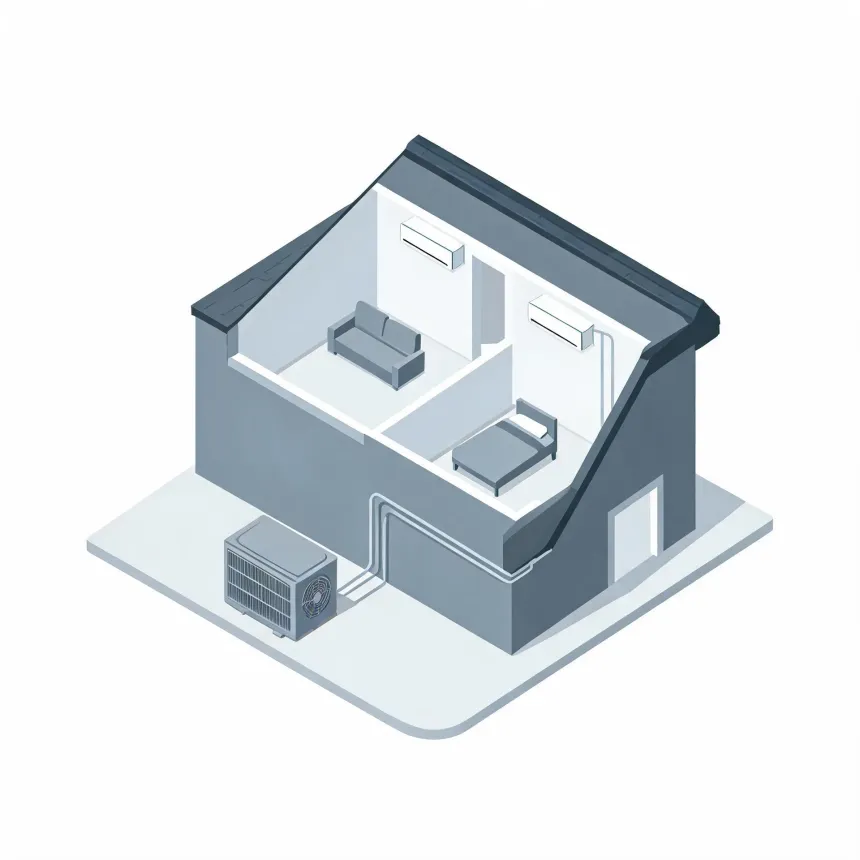
The cost of a mini split job comes down to what it takes to get refrigerant line from the outdoor unit to the indoor head and power to both. A short, simple run through an exterior wall costs less than one that has to travel up through a chase or across a long stretch of siding. Every additional indoor head adds its own line set, its own mounting, and its own labor, so a multi-zone system costs more than a single head even when the outdoor unit is shared. Electrical work matters too. Some installations need a new dedicated circuit and breaker, and that's separate work from the mechanical install itself. Where the outdoor unit sits plays in as well, since it needs clearance and a stable pad or mount, and a tricky spot takes longer to set than an easy one. The unit itself varies in price by capacity and by how well it holds output in cold weather, not by brand name alone.
Install day starts outside with the line set path. The crew runs refrigerant line and a power whip from the outdoor unit to the spot picked for the indoor head, through a small hole drilled in the exterior wall. That line gets insulated and sealed where it passes through, since a poor seal there is how air and moisture find their way in later. Inside, the head mounts to a bracket on the wall, and the line connects and gets checked for leaks before anything is charged. Outside, the compressor goes on a pad or wall bracket set level and clear of anything that would block airflow around it. The line then gets evacuated to pull moisture and air out before refrigerant is released into it. Last comes the test. Heating and cooling get cycled on, airflow gets checked at the head, and the outdoor unit gets watched to see that it starts and runs the way it should.