Most homes here run on gas
Utility gas heats 77.6% of homes in Otero County, with electricity a distant second at 13.3%. A furnace is the default here, not the exception.

Takes about a minute. No obligation.
Utility gas heats 77.6% of homes in Otero County, with electricity a distant second at 13.3%. A furnace is the default here, not the exception.
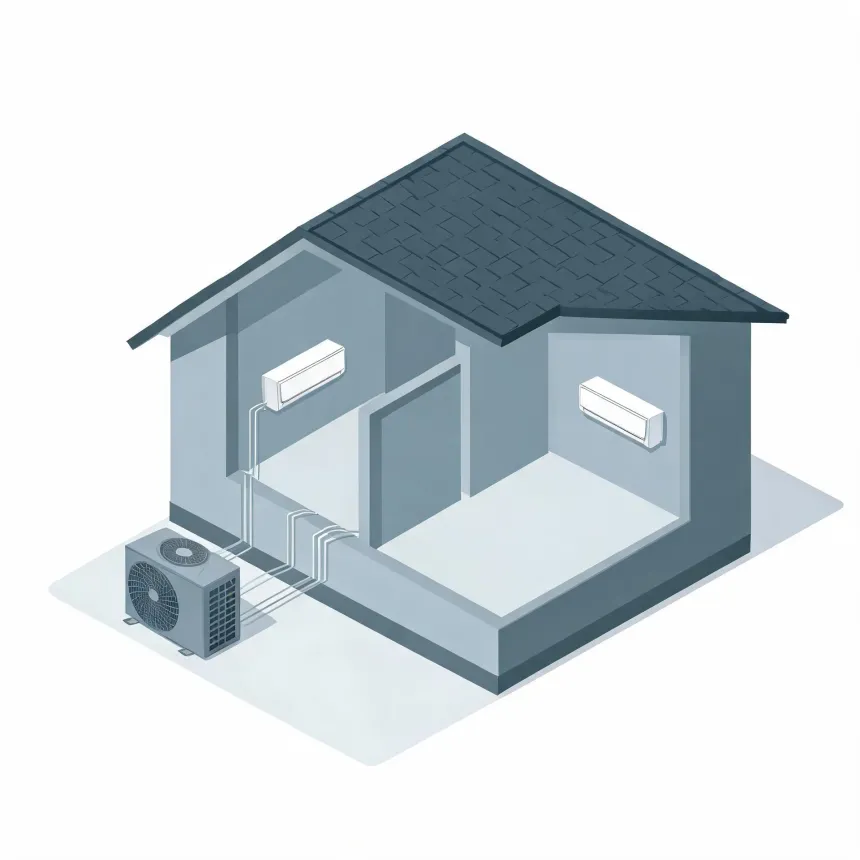
For most homes here, a mini split goes in alongside the furnace, handling a room or zone the ductwork doesn't reach well. Whoever installs it should know what's already heating the house.
NOAA nClimDiv, 1991–2020 normals
The old unit still gets removed, even if the new one only covers one room.
Whoever installs the mini split should take the old equipment with them, not leave it for someone else to haul off.



The line item that moves the price most is how many indoor heads the system runs and how far each one sits from the outdoor unit. A single zone with a short line set is one job. Several heads spread across different rooms, each needing its own run of refrigerant line through walls or attic space, is a longer and more involved one. Where the outdoor unit can sit matters too. A spot near an exterior wall with a clean path inside costs less to reach than one that needs line hidden around corners or run up through a second floor. The condensate line has to drain somewhere, and if gravity won't take it there, a small pump gets added to the job. Electrical work is its own factor. Some systems run on the same circuit as an existing outlet, others need a dedicated line back to the panel, and that's a different amount of work depending on how far the panel is and what's already available.
Otero County's code places La Junta in zone 4B, a mixed climate that asks real work of both heating and cooling. A ductless mini-split counts as a split-system heat pump under the federal standard, so a unit built from 2023 on has to meet 14.3 SEER2 for cooling and 7.5 HSPF2 for heating. That narrows what can legally go in, and it's worth sorting out before you settle on equipment.
Find a contractorHalf the homes in Otero County were built in 1958 or earlier. A house that age wasn't designed with a mini split's outdoor unit or line set in mind, and whatever wiring and wall construction it has now is whatever it was given over the years since. That's worth checking room by room, not assumed. The installer still has to find a real path for the line set and a real circuit for the power, in a house that was built for neither.
The right size for a mini split comes from a load calculation, not from matching square footage to a unit on a chart. That calculation weighs window area, insulation, ceiling height, and how many exterior walls the room has. A room facing west needs more cooling than one that doesn't, even at the same size. A room over a crawlspace loses more heat than one above a heated basement.
A mini split that's too big for the room cools it fast and shuts off before it pulls the moisture out of the air. The room ends up cold and clammy instead of comfortable. It also cycles on and off more than it should, and that wears the compressor faster than steady running would. A unit that's too small has the opposite problem. It runs constantly and still can't keep up on the hardest days.
The efficiency rating on the label is a ratio, cooling or heating output against the power it takes to produce it. A higher rating means more comfort for less electricity, but only when the unit is sized and installed the way it should be. A mini split with a strong rating still runs up the power bill if it's too big for the room and shutting off before it should, or too small and running flat out to keep up. That rating also assumes the refrigerant charge is correct and the line set was sealed properly going in. A unit with a bad charge burns more power than its label promises, no matter how good the number looked in the showroom. The rating tells you what the equipment is capable of. Whether the room actually sees that efficiency comes down to the load calculation and the install.
Installation day starts with the outdoor unit, not the indoor head. The installer sets it on a pad or wall bracket first, because that location decided the whole line set path before anyone picked up a drill. Mounting the indoor head comes next, high on the wall, level, with enough clearance to pull filters later. Then the hole gets cut for the line set, the refrigerant lines, power wire, and condensate drain, all bundled through a single pass into the wall. Once the lines are run and connected at both ends, the system gets evacuated with a vacuum pump to pull out moisture and air before any refrigerant moves through it. That step gets rushed on bad installs and it's the one that decides whether the system lasts. Only after the vacuum holds does the installer open the line and let refrigerant into the system, then run it to check airflow, temperature split, and drainage before calling the job done.