Gas heats most homes here
Utility gas heats 55.5% of homes in Clear Creek County, with LP gas covering another 20.7%. A furnace or boiler is what most houses in Idaho Springs already have doing the work.
Takes about a minute. No obligation.
Utility gas heats 55.5% of homes in Clear Creek County, with LP gas covering another 20.7%. A furnace or boiler is what most houses in Idaho Springs already have doing the work.
Installing a mini split here usually means putting in cooling or supplemental heat alongside the gas system already in place, not pulling out a furnace that's still doing its job.
Half the homes in Clear Creek County were built in 1976 or earlier, half in 1976 or later.
A mini split sized to the room handles either one, no special equipment needed for the older half.




Idaho Springs falls in climate zone 7, the coldest category in the energy code, and heating here runs most of the year. That changes what equipment is allowed in, not just what makes sense for the cold. A ductless mini-split counts as a split system under the federal standard, so it has to meet the same minimum efficiency as any other heat pump, 14.3 SEER2 for cooling and 7.5 HSPF2 for heating. There's no lower bar for ductless equipment because it's ductless. A system that meets that minimum qualifies for the federal tax credit on heat pump installations.
A standard size and efficiency fit fine here. There's no local reason to go bigger or pricier.
Find a contractor
A mini split here is barely working most of the year. With summer afternoons topping out around 68°F, the compressor just isn't cycling hard or long. Less run time under load means less wear on the parts that usually fail first. Pick a standard, reliable unit and let it do the light work it has here.
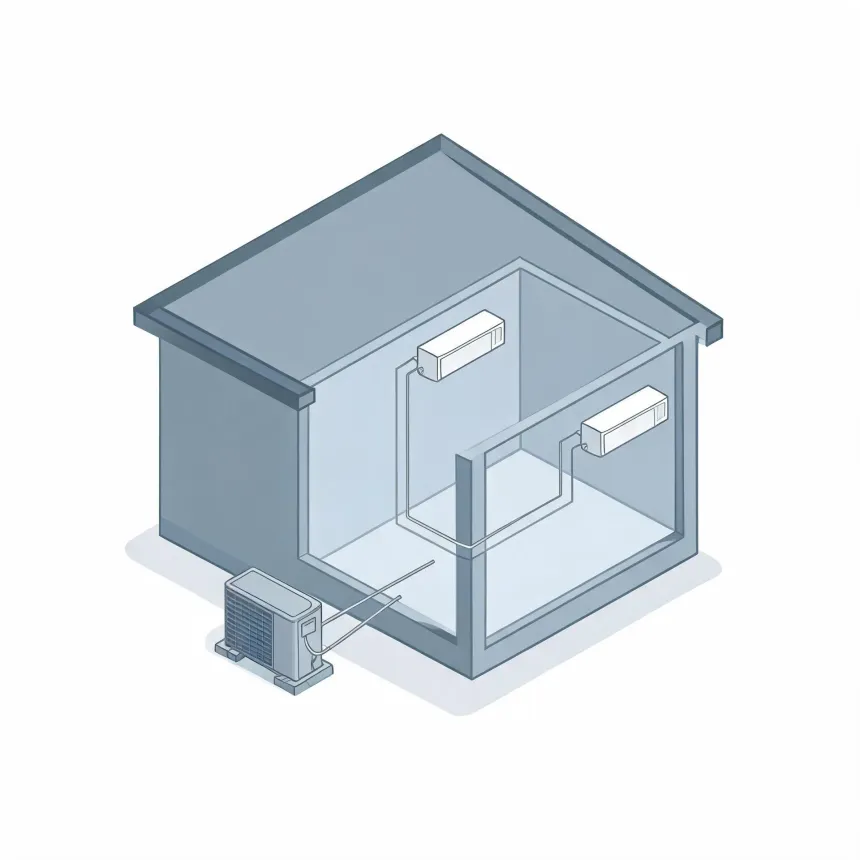
A single indoor head talking to one outdoor unit costs less than a multi-zone setup where one outdoor unit feeds several rooms. Each added indoor head means another line set, another spot for a contractor to mount and level, and a bigger outdoor unit to drive all of them. Pricing out a single room is a different job than pricing out a whole house.
The refrigerant line and wiring have to get from the outdoor unit to each indoor head, usually through an exterior wall. A straight shot through one wall is quick work. A longer run, one that has to clear framing, turn a corner, or climb between floors, takes more line set, more time, and more care sealing the penetration when it's done.
Ask what happens when the outdoor temperature drops low, not just what the unit is rated for. Every heat pump loses capacity as it gets colder outside, and the spec sheet should show output at a low temperature, not just at a mild one. Ask where the contractor plans to mount the outdoor unit, since it needs clearance for airflow and a way to shed snow and ice instead of sitting in a drift. Ask how the line set gets from outside to the indoor head, because the path through the wall affects how clean the install looks and how well it's sealed when the job is done. Ask what the warranty covers on the compressor, and ask separately who pays the labor if it fails, since that's often a different party entirely.
If this install is adding a mini split next to a furnace that already heats the place, the old system doesn't go anywhere. It keeps running. Nothing about putting in a ductless unit requires touching the existing ductwork, the gas line, or the furnace itself. Where an old system does get retired is when a mini split is replacing a window unit or an electric baseboard setup, and in that case the contractor hauls it away as part of the job. A window unit comes out of the window. Baseboard heaters get disconnected from their wiring and pulled off the wall, and that wiring either gets capped or reused depending on what's going in its place. Ask the contractor directly what happens to whatever you're replacing, since it's not always included in the quote.