Gas heats most homes here
Utility gas heats 73.5% of homes in Mesa County. Electricity comes next at 18.9%, with a small share on bottled or LP gas. A furnace or boiler is what most houses already have in place.
Takes about a minute. No obligation.
Utility gas heats 73.5% of homes in Mesa County. Electricity comes next at 18.9%, with a small share on bottled or LP gas. A furnace or boiler is what most houses already have in place.
Going into a gas-heated home, a mini split usually covers a room or zone the furnace doesn't reach well, or takes over cooling duty. Sizing it means looking at what the space needs on its own, not what the furnace already handles.
NOAA nClimDiv, 1991–2020 normals
Winter storms have hit Mesa County 182 times between 2015 and 2024.
A mini split sized right for the room handles that. It doesn't need to be built for worse than what actually shows up here.




Mesa County falls under zone 5B, a cool, dry climate where heating carries more of the load than cooling. Any mini split installed here has to meet the federal minimum for split-system heat pumps built from 2023 on. That means 14.3 SEER2 for cooling and 7.5 HSPF2 for heating. There's no separate ductless category, so the unit going on your wall meets the same floor as any other split system. That rules out older or stripped-down models that don't clear those numbers. A system that meets the standard may also qualify for the federal tax credit, worth checking against the specific equipment you pick.
Cooling here only has to carry two months, with afternoons averaging 83°F. That's not much of a job for a mini split to do year after year. You don't need the biggest unit or the highest efficiency number on the shelf. A smaller, reliable system sized to the room will handle it fine and hold up doing it.
Find a contractorMost of this comes down to how long you plan on keeping the system and what you're actually comparing it against. A mini split run for one season a year wears differently than one running most months, so ask what the compressor and coil are rated for in hours, not just years. Ask what happens to the warranty if the line set gets serviced by someone other than whoever installed it, since some manufacturers tie coverage to that. Ask whether the quote includes the vacuum process on the line set, because a system charged without pulling a proper vacuum first can run fine for a while and then fail early, and that failure won't look like an installation mistake from the outside. Ask what the sound rating is for the indoor head and the outdoor unit both, since that number varies more between models than people expect, and it's not something you can fix after it's hanging on the wall. A longer warranty or a quieter compressor matters more over time than a slightly higher efficiency number on the box.
If a window unit or electric baseboard was handling that room before, a contractor can usually pull it or leave it dead and disconnected. A mini split doesn't need the old equipment gone to go in, it just needs a clear spot on the wall and a path outside for the line set.
Adding a mini split doesn't mean decommissioning the existing heat source. The furnace keeps running the rest of the house the way it always has. The only change is that the room getting the mini split now has its own thermostat and its own way to heat or cool, separate from whatever the ductwork is doing everywhere else.
Sizing a mini split starts with the room, not a guess based on square footage alone. A contractor works out how much heat that space gains in summer and loses in winter, counting the windows, the exterior walls, the ceiling height, what's on the other side of each wall. Too big and the unit short cycles, kicking on, cooling the room fast, shutting off before it ever pulls the moisture out of the air. That leaves the room feeling clammy even at the right temperature. Too small and it runs flat out all day without ever catching up on the hottest afternoons. The right size runs longer, steadier cycles, which is also what keeps the compressor happy over the years. This is a load calculation, not a chart match, and it's worth asking whether the contractor is actually doing one.
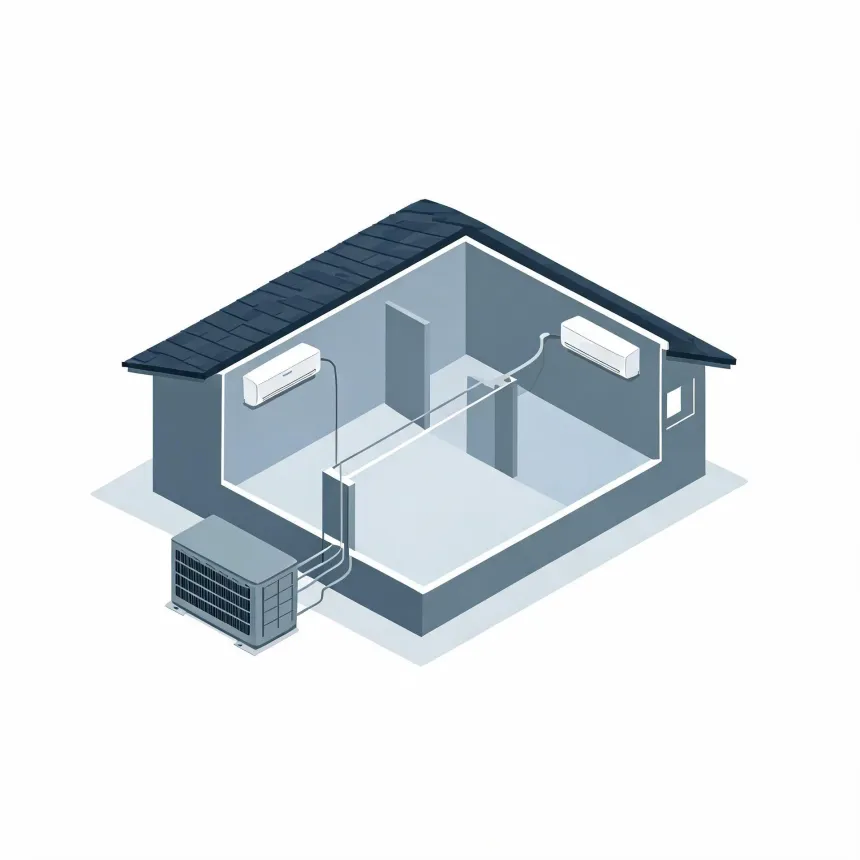
Install day starts with the line set, the pair of copper tubes running from the indoor head to the outdoor unit. That path gets drilled through the wall once, in one spot, so where the indoor unit hangs matters before anyone picks up a drill. The outdoor unit needs a pad or mounting brackets and clearance on all sides so it can actually move air. Once the line set is run, the contractor pulls a vacuum on the system to clear out air and moisture before the refrigerant ever gets released into it. Skip that step and moisture sits in the line, which causes problems well after the crew is gone. The indoor head gets mounted, the wiring gets connected, and the whole system gets tested running both heat and cooling before anyone calls it done.