



A gray cat sleeps curled up on a dark-made bed in a moody, minimalist bedroom with a wall-mounted air conditioning unit and warm accent lighting.

Mini Split Installation in Craig, CO

Tell us about the job

Takes about a minute. No obligation.

New system or replacementMini-splitMoffat County, CO
Step 1 of 2

What ZIP code is the job in?

Most homes in Moffat County heat with utility gas, 61.9 percent of them. Electricity accounts for 15.8 percent, and bottled or LP gas covers another 12.7 percent. A mini split works differently from a gas furnace. It heats and cools from the same outdoor unit, using electricity, so it doesn't replace a gas line the way a new furnace would. For a home already on gas, a mini split usually goes in alongside the furnace, covering a room or a zone the furnace doesn't reach well. For a home heating with electricity, it can take over more of the job.

9 months
September through May, your system heats
1 months
July through July, it cools
13°F
the average winter night it heats against
81°F
the average summer afternoon it cools against
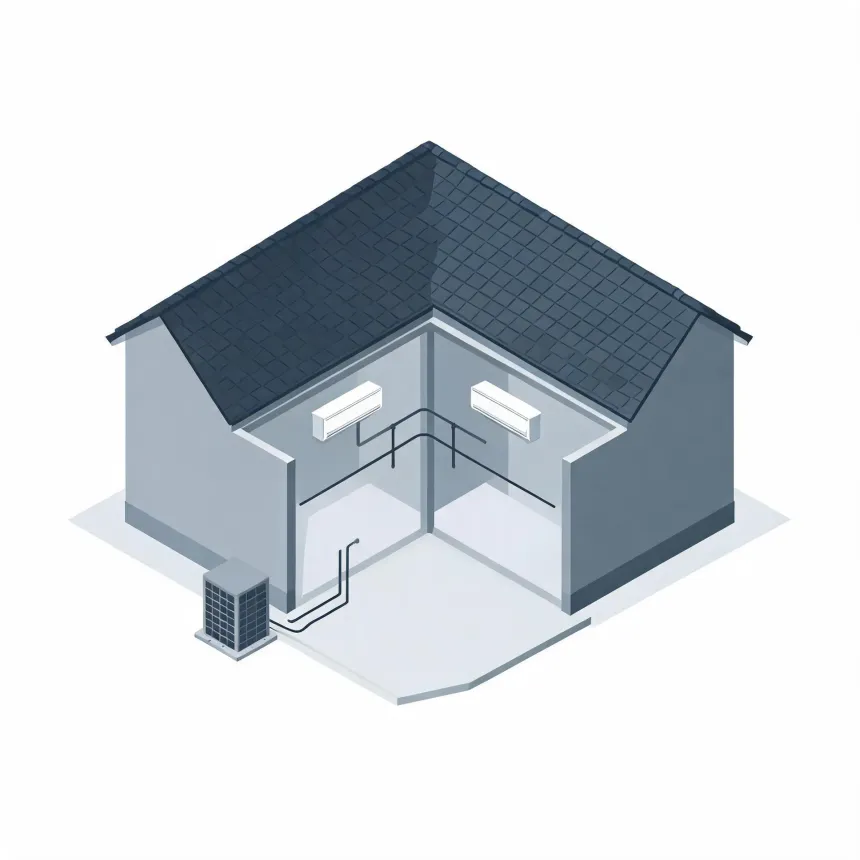
Isometric illustration of a cutaway gray house with a dark shingled roof, showing two wall-mounted indoor air conditioning units connected by piping to an outdoor condenser unit on the ground outside.
Your system heats September through May and cools July through July.

NOAA nClimDiv, 1991–2020 normals

Craig homes don't need an oversized mini split to handle a hard winter.

A standard size and efficiency rating covers the job here, so there's no reason to pay for more capacity than the room needs.

One month of cooling a year and mild highs. A mini split here doesn't work hard

Cooling runs July through July
Summer afternoons average 81°F
82 damaging wind events from 2015 to 2024

Moffat County sits in climate zone 6B, a cold zone with a long winter. Any mini split installed here has to meet the federal minimum for a split-system heat pump. That's 14.3 SEER2 for cooling and 7.5 HSPF2 for heating. The rule applies to the equipment itself, not to where it goes in, and it covers ductless systems the same as ducted ones. The standard doesn't treat them as a separate class. So the number on the spec sheet matters more than the brand or the size of the room it's heating. A unit that meets this minimum is built to get through a Craig winter without running past what it's rated for.

Reliability first

Power is cheaper here, so the most efficient model takes longer to pay off. Reliability and fit matter more.

Find a contractor
A white outdoor air conditioner condenser unit mounted on metal wall brackets against gray horizontal siding, with a blue sky and white clouds behind it.

One month of cooling means one month to get ready for it

July is the only month cooling runs in Moffat County. If a mini split is going in to cover summer heat, June is the month to have it done, before that one month arrives. Waiting until July means scheduling it while the unit is already needed, instead of before. The heating side doesn't carry the same deadline the same way, since a mini split installed for heat has months of mild fall weather before winter settles in. But for the cooling job, there's exactly one window where getting it done early matters, and it's the month right before July.

The outdoor unit and the indoor head aren't the whole job

A mini split needs a line set run between the outdoor unit and each indoor head, carrying refrigerant lines, a drain line, and electrical wiring through the wall. How far that run has to go, how many walls or floors it crosses, and whether it runs through finished space or an attic all change how much work the installation takes. A short, straight run through an exterior wall behind the indoor head is a different job than one that has to route around framing or up through a chase.
Each zone is its own installation

A single outdoor unit can run one indoor head or several, but every additional zone means another line set, another mounting point, and another spot that needs its own electrical and drain work. Covering one room costs less than covering several, not because the equipment changes much but because each zone adds its own run and its own labor. Matching the number of zones to the rooms that actually need separate control keeps the job from growing bigger than it needs to be.

If this is going in alongside an existing furnace, that furnace isn't going anywhere. It stays in place and keeps doing the job it's always done, with the mini split covering the room or zone it was installed for. There's no old equipment to remove in that case, no venting to cap, no gas line to deal with. The only thing that changes is where the heat for that one room comes from. If a mini split is replacing something, like an old window unit or electric baseboard heat, that's a separate removal, usually simple, since there's no ductwork or gas line tied to it. Either way, the mini split installation itself doesn't depend on what happens to the old system. It's a new line set, a new outdoor unit, and a new head on the wall, built to work on its own.

Install day starts outside, with the outdoor unit set on a pad or mounted bracket somewhere close to where the line set can run in. Inside, the indoor head goes up on the wall first, usually high, so the installer can mark where the line set needs to pass through. A hole gets drilled through the wall behind the head, just wide enough for the refrigerant lines, the drain line, and the electrical wiring to pass through together. Once those are run and connected at both ends, the system gets evacuated to pull out any air and moisture before refrigerant goes in, because either one left in the lines will cause problems later. After that, it's a matter of powering it on, checking the line pressures, and setting the head level so condensation drains the way it's supposed to. A single zone is usually done in a day. Add zones and the day gets longer, since each one needs its own hole, its own line set, and its own check before the crew is done.