Gas heats most homes here
Utility gas heats 69.3% of homes in El Paso County. Electricity is a distant second at 24.9%, with LP gas making up another 3.8%.
Takes about a minute. No obligation.
Utility gas heats 69.3% of homes in El Paso County. Electricity is a distant second at 24.9%, with LP gas making up another 3.8%.
Most mini split installs here go in alongside a gas furnace, covering a room or an addition the ductwork does not reach well. The furnace keeps doing the main heating.
NOAA nClimDiv, 1991–2020 normals
El Paso County recorded 717 hail events between 2015 and 2024.
Mount the outdoor unit where hail and wind-blown debris will not hit it directly.



Cooling here only runs July through August. Get a mini split installed in June and it's ready before the first hot week, with no scramble to find a crew. Wait until July and you're asking for an install while the unit is already needed, which usually means a longer wait to get on a contractor's schedule. June also gives any wrinkles, a tight line set run, a tricky spot for the outdoor unit, time to get sorted before the system has to carry a room through summer.
Colorado Springs falls in climate zone 5B, where heating carries most of the load. A ductless mini split counts as a split-system heat pump under the federal standard, so a unit made from 2023 on has to meet 14.3 SEER2 for cooling and 7.5 HSPF2 for heating. That sets the floor for what a contractor can install. A federal tax credit is available on top of that for equipment that qualifies.
Find a contractorA mini split that's too big cools the room fast and then shuts off before it pulls the moisture out of the air. The room feels cold and damp instead of comfortable, and the compressor spends its life starting and stopping instead of running a steady cycle. That short cycling is hard on the compressor and it never settles into the efficient range it was built to run in. Too small, and it runs flat out on the hottest and coldest days and still can't hold the temperature you set. Sizing is worked out with a load calculation, not a guess based on the square footage of the room. It accounts for the windows, the insulation, the ceiling height, and which way the room faces, then matches that load to a unit's output at both the low end and the high end of its range. Get it right and the system runs long, steady cycles and holds the room wherever you set it.
A mini split system with one indoor head costs less to install than one built to cover several rooms. Each added zone means another indoor unit, another line set run, and another spot the outdoor unit has to support. The outdoor unit itself has to be sized to handle every zone running at once, not just the biggest one.
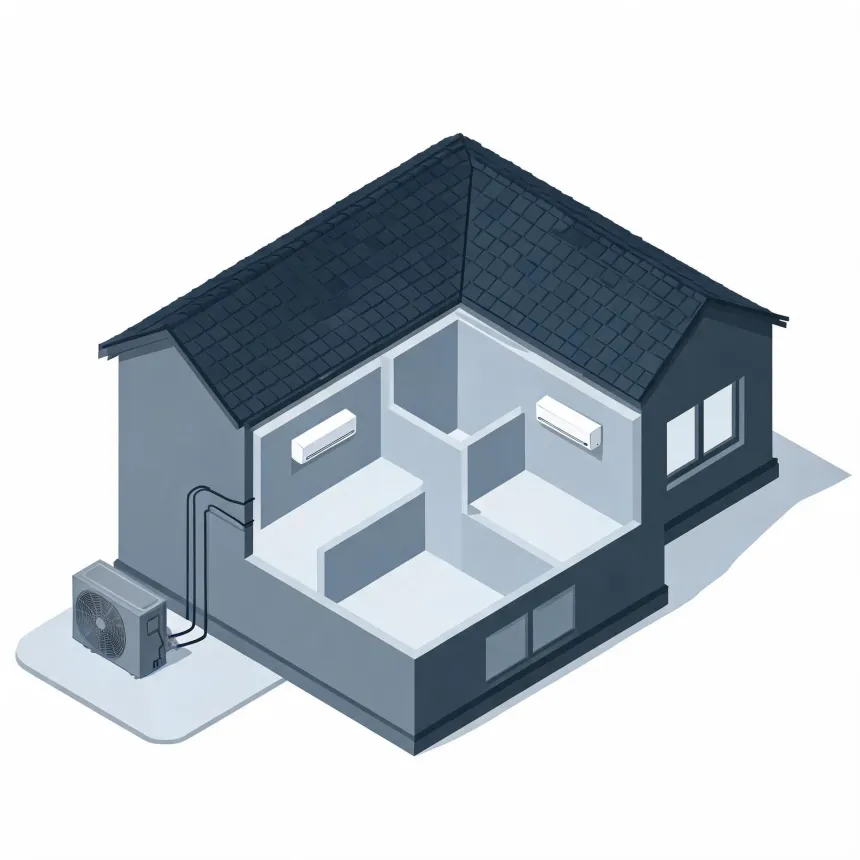
The refrigerant line runs from the outdoor unit to each indoor head through a hole drilled in the wall, and the path it takes affects the work. A short, straight run through an exterior wall is the simplest case. Running the line through an attic, around framing, or up multiple floors takes more labor and more material, and it changes where the outdoor unit can reasonably sit.
Comparing mini splits means comparing more than the price on the quote. Ask what the SEER2 and HSPF2 numbers are for the exact model listed, not the line of equipment it comes from, since those ratings shift between versions. Ask how many zones the outdoor unit is rated to run at once, and whether that rating assumes all of them running together or just the biggest draw. Ask what happens to the warranty if the line set is longer than standard, since some manufacturers tie coverage to installation specs. Ask who commissions the system once it's in, meaning who checks the refrigerant charge and airflow against the manufacturer's numbers rather than just switching it on. A contractor who answers these without pulling out a chart probably installs this equipment often.
Install day starts outside and in at the same time. The outdoor unit gets mounted on a pad or bracket, the indoor head goes up on its wall plate, and the line set runs between them through a hole drilled for that purpose. Once the lines are connected, the installer pulls a vacuum on the system to clear out air and moisture before any refrigerant moves through it. Skip that step or rush it and moisture sits in the lines, which leads to corrosion and a loss of cooling and heating capacity down the road. After the vacuum holds, the system gets charged and commissioned, meaning the installer checks the refrigerant charge and airflow against the manufacturer's numbers rather than just switching it on and walking away. The last part is the electrical hookup, usually its own dedicated circuit back to the panel.