A dark modern bedroom with grey bedding, a wall-mounted air conditioning unit, and a cat resting on the bed.

Mini Split Installation in Broomfield, CO

Tell us about the job

Takes about a minute. No obligation.

New system or replacementMini-splitBroomfield County, CO
Step 1 of 2

What ZIP code is the job in?

Gas heats most homes here

71% of homes in Broomfield County heat with utility gas, and most of the rest use electricity. A mini split is a different kind of system from either one, since it moves heat instead of burning gas or running resistance coils.

What that means for adding one

If your house runs on a gas furnace, a mini split usually goes in as a second system, cooling or heating specific rooms without touching the ductwork or the gas line. It doesn't replace the furnace, it works alongside it.

8 months
October through May, your system heats
3 months
June through August, it cools
20°F
the average winter night it heats against
86°F
the average summer afternoon it cools against
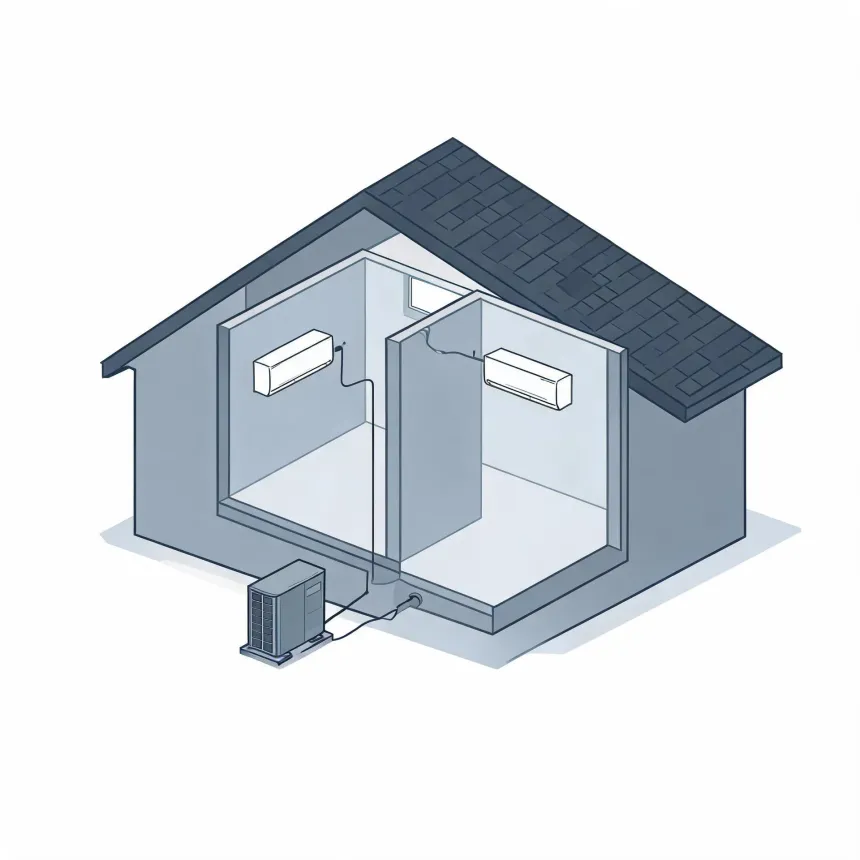
Isometric line illustration of a cutaway house with two rooms, each with a wall-mounted indoor air conditioning unit connected by lines to an outdoor condenser unit on the ground outside.
Your system heats October through May and cools June through August.

NOAA nClimDiv, 1991–2020 normals

Cooling in Broomfield County starts in June and runs through August.

Get a mini split installed in May, ahead of that, so it's running before the first hot day asks it to.

A standard mini split handles summer here. Nothing about Broomfield calls for sizing up.

Power costs 14.92 cents a kWh statewide
Cooling runs June through August
Summer afternoons average 86°F
A mini split here isn't working hardThree months of cooling a year, averaging 86°F in the afternoon.

Broomfield County sits in climate zone 5B, a cool, dry zone where heating carries more of the load than cooling. Any mini split installed here has to meet the federal minimum for split-system heat pumps. That's 14.3 SEER2 for cooling and 7.5 HSPF2 for heating, for units built on or after January 2023. The rule applies the same whether the unit is ducted or ductless, since there's no separate ductless category. A unit meeting those numbers is built to handle both the summer cooling load and a real share of the winter heating load here. A federal tax credit may apply too, worth checking against the specific model before deciding.

Pick a mini split sized for the job here, not above it

A mini split here only has to get through three summer months, so a standard model built to the federal minimum is enough machine for the job. Put the money into a correct install instead of a bigger unit.

Find a contractor
A man in a dark jacket, beanie, and tan pants seen from behind carrying a worn canvas duffel bag as he steps up porch stairs toward a red front door.
A white outdoor air conditioner condenser unit mounted on metal wall brackets against gray horizontal siding, with a blue sky and white clouds behind it.

The furnace still does the hard part

When a mini split goes in alongside a furnace, the furnace doesn't go anywhere. It keeps carrying the winter heating load, the same load it always has, since one mini split handling a few rooms isn't built to replace it. What changes is how often the furnace runs during the stretch of the year the mini split can also heat or cool on its own. A furnace that used to cycle on for a mild morning may sit idle more during those months. That's not hard on it. Sitting unused doesn't wear a heat exchanger or a blower motor the way running does, and fewer cycles usually means less wear on the igniter over time. Nothing about adding a mini split changes what the furnace needs for its own filter changes and yearly checks, and it still has to be sized and maintained for the coldest stretch of the year on its own.

The rating only holds if the install matches it

The efficiency number on a mini split comes from lab testing with the refrigerant charge and airflow set exactly right. If the line set run is too long, the charge is off, or the indoor head is the wrong size for the room it serves, the unit won't run anywhere near that number, no matter what the label says. The label describes the equipment. What the homeowner gets depends on whether the person installing it sets it up to match.

Cooling and heating are rated separately

A mini split carries one rating for how it cools and a different one for how it heats, and neither number tells you the other. The compressor and coils doing the cooling work are the same parts doing the heating work, just moving heat in the opposite direction, so a unit can be strong on one side and only adequate on the other. Both ratings matter for a system that's expected to run in both directions.

Sizing a mini split starts with a load calculation, not a tape measure around the room. A tech works out how much heat the space gains in summer and loses in winter, counting the windows, the direction they face, the insulation in the walls and ceiling, and what's generating heat inside, like a kitchen or a row of west-facing glass. Square footage alone misses all of that. A room sized by square footage can end up with a unit too big for the job, and too big is its own problem. An oversized mini split cools the room fast, shuts off, and starts again a few minutes later, which keeps the compressor cycling instead of running steady. That short cycling leaves the air colder but wetter, since the coil never runs long enough to pull real moisture out of it. A correctly sized unit runs longer at a lower output, holds the temperature steady, and does the job the coil is built to do.

Install day starts before anyone touches the wall. The line set route gets planned first, the path the refrigerant lines and the condensate drain will take from the outdoor unit to the indoor head, since that path decides where the head can actually go. The outdoor unit gets set on a pad or mounted bracket with room around it for airflow. Mounting the indoor head means a hole through the exterior wall for the line set, the drain, and the electrical whip, then the lines get connected and the whole system gets pulled down to a vacuum before any refrigerant moves. That vacuum step pulls out the moisture and air that don't belong in the line set, since either one left behind will show up later as a loss of capacity or a coil that ices over. Once the system holds vacuum, the tech charges it, powers it up, and checks that it's cooling and heating the way the room calls for.