



A white wall-mounted split-system air conditioner on a blue-grey wall, with a full moon visible through a curtained window at night.

Mini Split Installation in Alamosa, CO

Tell us about the job

Takes about a minute. No obligation.

New system or replacementMini-splitAlamosa County, CO
Step 1 of 2

What ZIP code is the job in?

Utility gas heats close to half the homes in Alamosa County, with electricity and propane splitting most of the rest. A mini split works differently from what's already in your walls or utility closet. It doesn't replace a furnace outright, it adds heating and cooling that runs on electricity, delivered room by room instead of through ducts. For a home on gas or propane, that means a second system to size and place, not a swap of one unit for another. Worth asking any contractor how it should work alongside what you already have.

9 months
September through May, your system heats
8°F
the average winter night it heats against
80°F
the average summer afternoon it cools against
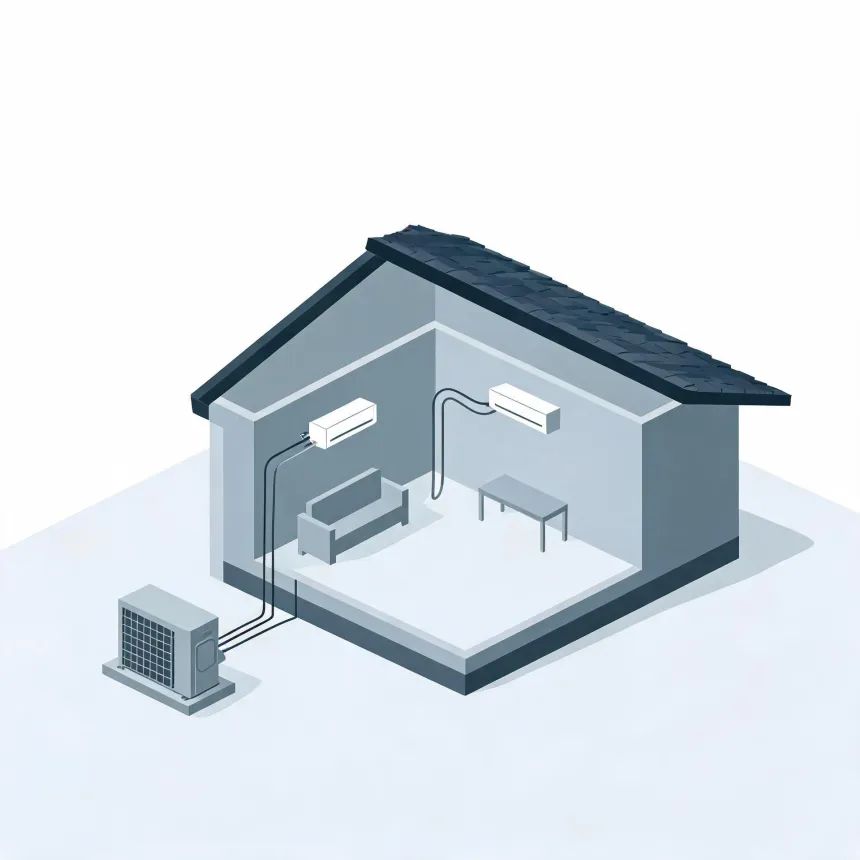
Isometric illustration of a cutaway house showing two wall-mounted indoor air conditioning units connected by line sets to an outdoor condenser unit, with a sofa and table inside the room.

Colorado electricity ran 14.92 cents per kilowatt-hour in 2024, cheaper than most states.

A mini split still has to earn its keep on how well it heats and cools this house, not just on the electric bill.

Alamosa sees its share of wind and winter storms, but that doesn't change what size mini split you need

178 severe weather events from 2015 to 2024
13% of homes statewide lost power a day or more in 2024
82 damaging wind events from 2015 to 2024

Summer afternoons here average 80°F across June, July and August, and the rest of the year barely asks for cooling at all. A mini split's compressor just doesn't have much to push against, even in the hottest stretch of summer. That's an easy job compared to what these systems handle in hotter states. Wind is more of a factor than heat, with damaging wind hitting the county 82 times over the past decade, so the outdoor unit needs to be mounted and secured with that in mind. None of this calls for the highest efficiency model on the market. A reliable mini split sized right for the space will hold up fine here.

A mini split here has to meet zone 6B's standard. Get a quote that starts from there.

Any mini split installed here now has to hit 14.3 SEER2 for cooling and 7.5 HSPF2 for heating, the federal minimum for split-system heat pumps. That's the baseline, not a ceiling, so it narrows the field without ruling out a system sized right for this house. A federal tax credit is available for qualifying heat pump installations, worth asking about when you're comparing units and quotes.

Find a contractor
A white mini-split air conditioner outdoor condenser unit mounted on metal brackets against a beige stucco exterior wall, with a blue sky and scattered clouds in the background.

The label tells you less than the install does

That SEER2 and HSPF2 number on the label comes from a lab test, run at one set of conditions. It says nothing about how the system behaves mounted outside, running day after day in this particular house. A higher rated unit can still underperform a lower rated one if it's oversized for the space, starved for airflow where it's placed, or hooked up with a sloppy line set. The rating also doesn't know how hard the compressor will actually have to work wherever it ends up. A unit pushed near its limit most days wears differently than one that's rarely tested. Efficiency on paper assumes a clean install and a size that matches the space. Get either wrong and the number on the label stops telling you much.

How many zones, and from how many outdoor units

A mini split system can run several indoor heads off one outdoor compressor, or you can split the house into separate systems. More zones on one compressor costs less to install but means the whole system shares one unit's capacity. Ask how the contractor is dividing the house and why, not just how many heads you're getting.
What happens on the coldest night

Every heat pump loses capacity as the air outside gets colder, and the spec sheet should show output at low temperatures, not just at a mild rating point. Some systems hold most of their heating capacity down to single digits, others fall off hard. If the quoted system can't carry the house on the coldest night of the year, ask what backup heat is supposed to cover that gap.

What drives the cost on a job like this comes down to what the crew has to do to get refrigerant line and wire from the outdoor unit to each indoor head. A straight run through an exterior wall with a clear path for the line set is the simple case. Longer runs, runs through framing or finished ceilings, or a line set that has to climb several floors all add labor, and some of that isn't visible until the wall is open. The number of zones matters too, since each indoor head needs its own line set, its own power, and its own spot picked for airflow, not just a convenient wall. Electrical work is often part of it. Many homes need a dedicated circuit run to the outdoor unit, and that's a different job depending on how far the panel is and how much capacity it has free. Where the outdoor unit ends up mounted counts as well, since a condenser set on a stand over a simple pad costs less to install than one that needs a bracket on an upper floor or a reinforced base. None of this shows up on a spec sheet. It shows up when someone walks the house and traces the path the lines actually have to take.

Installation day starts with the walkthrough the quote was based on, confirming where each indoor head goes and the path the line set will actually take. The crew mounts the indoor units first, usually high on a wall or near the ceiling, then drills through to run refrigerant line, a condensate drain and electrical wire out to where the outdoor unit sits. That outdoor unit gets set on a pad or bracket, leveled, and connected before anyone touches the refrigerant. The lines get purged of air and moisture with a vacuum pump before the system is charged, a step that matters more than people expect, since trapped moisture or air in the line can wear on the compressor for years afterward. Once it's charged, the crew runs the system in both heating and cooling to check airflow at each head and confirm it holds the temperature it's set to. A clean job wraps with the wall penetrations sealed and the line set covered, not left exposed to the weather.